How to Maintain a Consistent Client Outreach Cadence

Clients rarely leave over one bad interaction. They drift when they go months without hearing from you. The fix is a repeatable outreach model that keeps your firm visible and gives clients steady reasons to come back to the app.
The baseline we recommend: three to five intentional outreach communications a month, built into the broader client relationship and your service model. Build that cadence from the communication, content, events and resources your firm already creates or receives.
Plan your cadence with the fill-in worksheet
Every step below comes with a fill-in table: your current touchpoints, your cadence map, your owners and your plan. Copy it and work through it with your team.

Start With the Right People
Bring together a small group that understands:
- What client communication already happens today
- What content and resources are available
- How communication is reviewed or approved
- Which client audiences need different outreach
- How Fynancial Outreach is administered
Include the people who will actually plan, approve, contribute to or send client outreach.
Scale the Playbook to Your Firm
A smaller firm may run one shared cadence across its whole client base. A multi-office or enterprise firm may set a firm-wide baseline and let offices, teams, advisors or client segments add their own communication on top.
Decide which standards are firm-wide, segment-specific, team or office-specific, and advisor-specific. The goal is a deliberate outreach model with clear ownership at each level.
Still choosing a communication model? Start with Client Touchpoint Strategies You Can Run in Fynancial for personalized, standardized and hybrid models with sample cadences.
Audit What Clients Receive Today
List your current touchpoints: market updates, newsletters, advisor check-ins, educational content, planning reminders, events and resources. For each one, note who receives it, how often, where it's delivered, who owns it, and whether to keep, adjust or stop it.
Then ask:
- What useful communication are we already creating or paying for?
- What are advisors already sending directly to clients?
- Are there long stretches when clients hear nothing from us?
- Are multiple teams sending overlapping communication?
- Which touchpoints should be broad and which should be personal?
- What could we reuse instead of recreating?
- Which existing touchpoints should move into the app or be reinforced there?
Define Your Outreach Mix
- Posts for recurring firm, market, planning or educational communication
- Messages for personal or targeted outreach
- Action Items when the client needs to complete a task
- Reminders for deadlines and timely prompts
- Custom Notifications for important, time-sensitive alerts
- Events for webinars, education or client events
- Resources and Featured Resources for information clients should be able to find again
Use Segmentation on Purpose
Use Tags, Contact Types, individual contacts or broader audiences to match outreach to the people it's most relevant to. Common segments:
- Client type or tier
- Life stage
- Planning need
- Business owners or retirees
- Office, team or advisor
- Event participation
- Other firm-defined groups
Keep segmentation useful and manageable.
Map Your Outreach Cadence
Turn the strategy into a repeatable set of touchpoints. Give each one a purpose, a delivery method, an audience, a frequency and an owner. A starting map:
- Market update: keep clients informed. Post
- Advisor check-in: personal outreach. Message
- Planning task: request action. Action Item
- Deadline prompt: reinforce timing. Reminder
- Timely alert: drive attention. Custom Notification
- Educational event: invite participation. Event
- Quarterly focus: highlight priorities. Post + Resource
Pressure-Test the Cadence
- Are clients hearing from us consistently?
- Are we balancing information, personal outreach and client action?
- Are we using the right Fynancial tool for each touchpoint?
- Are we duplicating communication clients already get elsewhere?
- Is each audience getting communication relevant to them?
- Can our team realistically keep this up?
- Is ownership clear?
Decide How Outreach Will Run
Once the cadence is set, write down your firm's standard for each of these:
- Who plans recurring outreach?
- Who selects content?
- Who reviews or approves communication?
- Who sends or schedules each touchpoint?
- How far ahead will outreach be planned?
- Who decides the audience?
- When should communication come from the firm, and when from the client's Primary Advisor?
- What can offices, teams or advisors add to the firm-wide cadence?
- Who checks upcoming communication for silent stretches or duplication?
- Who adjusts the cadence when priorities change?
Every recurring touchpoint needs a clear owner. Larger firms should also define what's managed centrally and what an office, team or advisor manages.
Set Up Fynancial Around the Cadence
1. Choose the right delivery method
Posts for recurring Feed communication. Messages for personal or targeted communication. Action Items when the client needs to complete a defined task. Reminders for deadlines. Custom Notifications to draw immediate attention to a specific update. Events for scheduled client interactions.
2. Review your audiences
Decide who receives each touchpoint: individual contacts, Tags, Contact Types or a broader client population. Segment when the communication is genuinely more relevant to a defined group.
3. Review the sender
For applicable outreach, decide whether it should come from the user creating it or from the contact's Primary Advisor. Use the sender that best reflects the experience your firm wants to create.
Review the Full Schedule
Look over upcoming outreach for stretches with no communication, duplicate or conflicting messages, unnecessary volume, missing audiences, too much reliance on one type of touchpoint, and timing that no longer makes sense. Larger firms should review the firm-wide cadence and the outreach offices, teams and advisors have planned on top of it.
Make the Cadence Repeatable
Plan ahead. Keep a forward-looking communication calendar instead of deciding what to send week by week.
Reuse what already works. Market commentary, newsletters, educational articles, advisor communication, events, firm updates and approved provider content can all feed the cadence.
Build around predictable touchpoints. Use the communication you know will happen as the foundation:
- Monthly newsletter → Post
- Market commentary → Post
- Quarterly advisor check-in → Message
- Planning task → Action Item
- Upcoming deadline → Reminder
- Important timely update → Custom Notification
- Quarterly planning theme → Resource + supporting Post
- Educational webinar → Event + follow-up communication
Add context. Give clients enough to understand why the communication matters and what, if anything, they should do next.
Keep the rhythm steady. A manageable model kept up all year beats bursts of heavy communication followed by long silences.
Leave With a Plan
Before you call this done, you should be able to finish each line:
- Our recurring client touchpoints are…
- Our baseline outreach cadence is…
- Our primary client audiences are…
- What we manage firm-wide is…
- What may vary by segment, office, team or advisor is…
- Planning and execution are owned by…
- Review and approval are owned by…
- We plan this far ahead…
- We review and adjust the cadence…
You're ready when your firm has a defined outreach cadence, clear recurring touchpoints, the right audiences, clear ownership and a plan for running each touchpoint through Fynancial.
Leave this page with a plan
Copy the worksheet, fill in your touchpoints, owners and baseline cadence, and schedule your first month in Fynancial.

The Fynancial Insights team writes on enterprise value, client experience architecture, and the platform decisions that shape valuation for independent advisory firms.
Related Insights




What firms say after launching with Fynancial
I am not exaggerating when I say our app has helped us win over $10M in new AUM between two separate prospects. The vision Fynancial has is incredible!

This highly personalized communication solution enables us to connect with clients like never before. Delivering real advice from real advisors with authentic, timely, human-centered guidance.

The Prime Capital app is our all-in-one hub. Seamless advisor to client communication, fully integrated with our core tech stack. The Salesforce integration ties it all together perfectly.

We are currently managing the majority of our client relationships daily through our app. It has been a game-changer, and I cannot say enough positive things about Fynancial and their entire team.

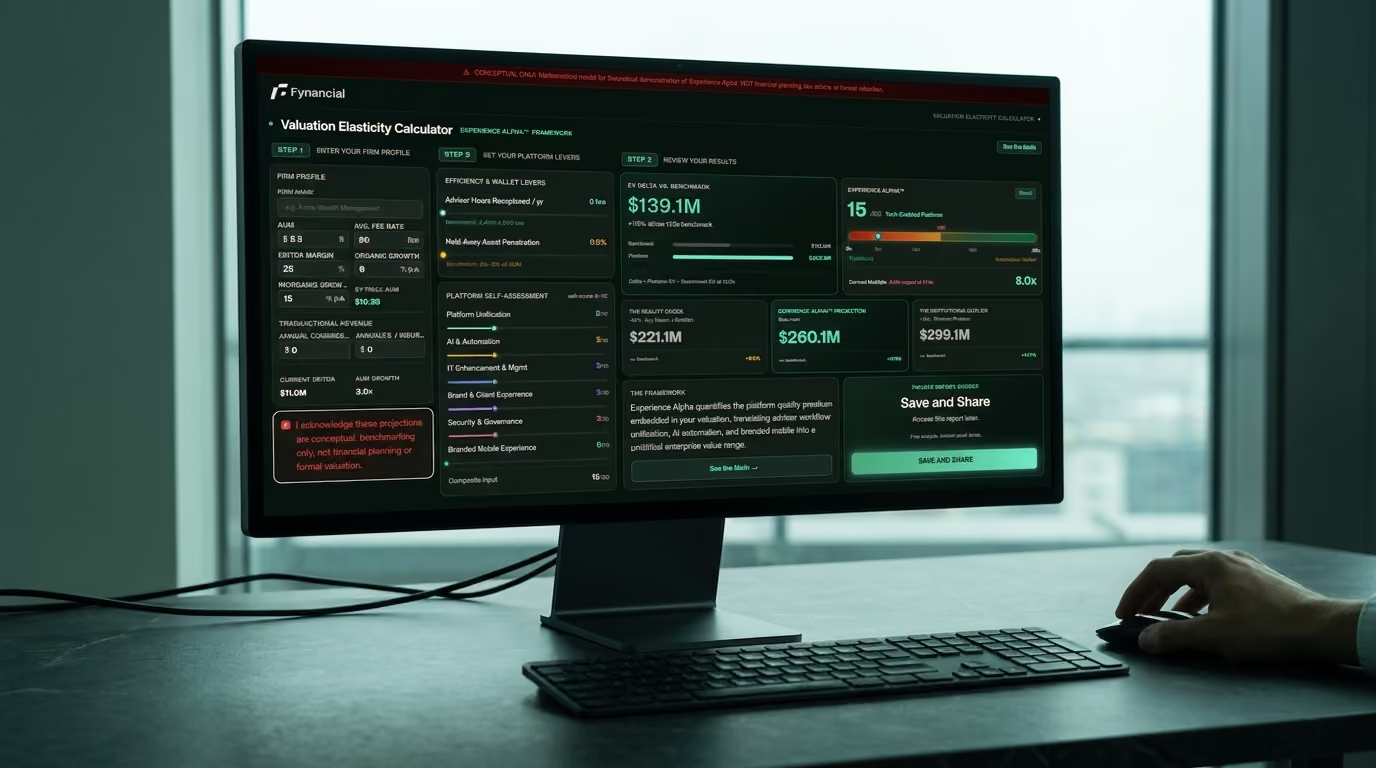
See your Platform Premium in 2 minutes
Model AUM → multiple uplift. Live. Under 2 min.
Enter AUM, headcount, and growth. The calculator maps how a branded client layer can move your valuation multiple, recalculating as you adjust inputs.