The client who left because he never heard from us
Thirteen minutes recorded live in Miami, with the full timestamp breakdown

When you have your own platform, you don't have to battle algorithms. You can put the right content or the right message in front of the right eyeballs.
Tom Fields lost the largest client he had.
Not to a competitor with better numbers, and not over fees. When he found out why, the reason was that the client felt he had not heard from Tom in months.
Here is the part that should bother anyone running a firm. During that same stretch, Tom was producing constantly. He was posting on LinkedIn. He was running a YouTube channel. By any reasonable measure of effort he was one of the more visible advisors in his market. None of it reached the one person whose account mattered most, because none of those channels belonged to him. Every one of them decides for itself, every day, who sees what.
That is the observation Fynancial was built on, and it is the story Tom tells most clearly on a thirteen minute recording made on a conference floor in Miami.
Recorded on the floor, which is why it is good
The episode is On the Circuit, number 32, hosted by Johnny Sandquist. Sandquist runs Three Crowns, a marketing firm that works only in financial services: copywriting, branding, websites and podcast production for advisors and fintech companies. He is not a journalist looking for a narrative. He is someone who sells marketing to advisors for a living, which means he knows which claims in this category are load bearing and which are decoration.
That season was recorded at the Fearless Investing Summit, Nitrogen's annual conference, with guests pulled off the floor between sessions. The format does something a studio booking cannot. No pre-interview, no warm up, no time. Twelve minutes and forty six seconds, start to finish, in a room with several hundred advisors walking past.
What comes out of that constraint is the cleanest public version of the founding argument, told before the company had a category name to hide behind.
Owning the channel, and what that actually buys
The line Sandquist pulled for his own write-up is the one worth sitting with:
"When you have your own platform, you don't have to battle algorithms. You can put the right content or the right message in front of the right eyeballs."
Read quickly, that sounds like a marketing claim. It is closer to a structural one.
An advisor posting on LinkedIn is making a bid in an auction they cannot see, against every other bidder in that client's feed, for a slot the platform assigns on its own logic. The advisor's largest client and a stranger three degrees removed are treated identically by that system. Effort does not convert into reach in any predictable way, which is exactly what Tom experienced: high output, and a client who genuinely believed he had gone quiet.
A firm's own application inverts that. Delivery is deterministic. A message goes to the person it was written for, and it arrives on the device that person already checks dozens of times a day. The competitive set collapses from every content producer on earth to whatever else is on that lock screen at that moment.
Around the seven minute mark Sandquist gets Tom onto the thing clients actually complain about, which is not reach at all. It is logins. Every additional set of credentials is friction the client never asked for, and the advisor absorbs the annoyance. That is a smaller point than the algorithm argument and it is probably the more persuasive one, because a principal can verify it this week by asking their service team how many password resets they handled last quarter.
Then compliance, near the end, where Tom's answer is correct and slightly unusual for a founder. The company does not exist unless that is solved first, so it was solved first. Not a feature. A precondition.
What makes the channel work
Owning the channel solves distribution. It does not solve the harder question underneath, which is whether the firm has anything worth distributing.
An app every client has downloaded and nothing on it is a more expensive silence than the one Tom's client experienced. The firms getting real engagement out of this are running an actual cadence with someone accountable for what goes into it. That is an operating commitment rather than a software purchase.
The second piece is exclusivity. The channel works when it becomes the channel, and that is a leadership decision rather than a rollout task. The firms with the strongest numbers are the ones where somebody senior said this is where client communication happens now, and meant it. Add an app alongside email, text and an existing portal and you have a fourth thing nobody opens.
What to check inside your own firm
Pick your five largest relationships. For each one, write down the last time they heard something from your firm that was not a statement, a scheduling email, or a market update sent to everybody.
Most principals who do this find one or two names where the honest answer is longer ago than expected, and the reason is almost never that nobody was working. It is that the work went out through channels that decide for themselves who receives it.
Tom found that out through a resignation. It is a cheaper lesson to learn from a list.
Related: Tom makes the adoption half of this argument with Jason Pereira on Fintech Impact, and the channel itself is laid out on the client communication page.
The conversation, in short
Sandquist opens by asking why an advisor should care about Fynancial, and Tom answers with the origin rather than the product. He was an advisor. He lost his biggest client. The client's reason was silence, during a period when Tom was publishing regularly on channels he did not own.
From there the conversation moves through four things. A worked example of what advisors actually put in the app, and the kind of material that earns attention rather than filling a feed. The login problem, as the friction clients feel daily and blame the advisor for. Compliance as a precondition, and Tom's position that a communication platform in this industry is not viable unless archival and record keeping are handled before anything else ships. And keeping clients engaged, in answer to the closing question the show puts to every guest that season.
The through line is ownership. Not owning the technology. Owning the channel, so the firm decides who hears from it.
Key moments
Timestamps as published by Three Crowns.
01:01 Introduction to Fynancial
02:58 Tom's background as an advisor, and how losing his biggest client led to the idea
05:29 Real examples of how advisors use the platform and what they post
07:39 Multiple logins, and simplifying the client experience
10:30 Compliance in fintech
11:18 Closing question on keeping clients engaged
Transcript
Three Crowns does not publish a transcript for this episode. The quote above is taken from their own written summary, and the timestamps are theirs.
Listen
On the Circuit, episode 32, hosted by Johnny Sandquist for Three Crowns Marketing. Recorded at the Fearless Investing Summit, Miami. Published November 7, 2023. Runtime 12:46.
Apple Podcasts: https://podcasts.apple.com/us/podcast/id1665945938?i=1000633999247
Episode page: https://threecrownsmarketing.com/blog/tom-fields/
Nathaniel Stout is Head of Media at Fynancial and a U.S. Air Force combat camera veteran. He leads brand messaging, content strategy and video production, and edits the Fynancial blog.
Related Insights




What firms say after launching with Fynancial
I am not exaggerating when I say our app has helped us win over $10M in new AUM between two separate prospects. The vision Fynancial has is incredible!
This highly personalized communication solution enables us to connect with clients like never before. Delivering real advice from real advisors with authentic, timely, human-centered guidance.
The Prime Capital app is our all-in-one hub. Seamless advisor to client communication, fully integrated with our core tech stack. The Salesforce integration ties it all together perfectly.
We are currently managing the majority of our client relationships daily through our app. It has been a game-changer, and I cannot say enough positive things about Fynancial and their entire team.
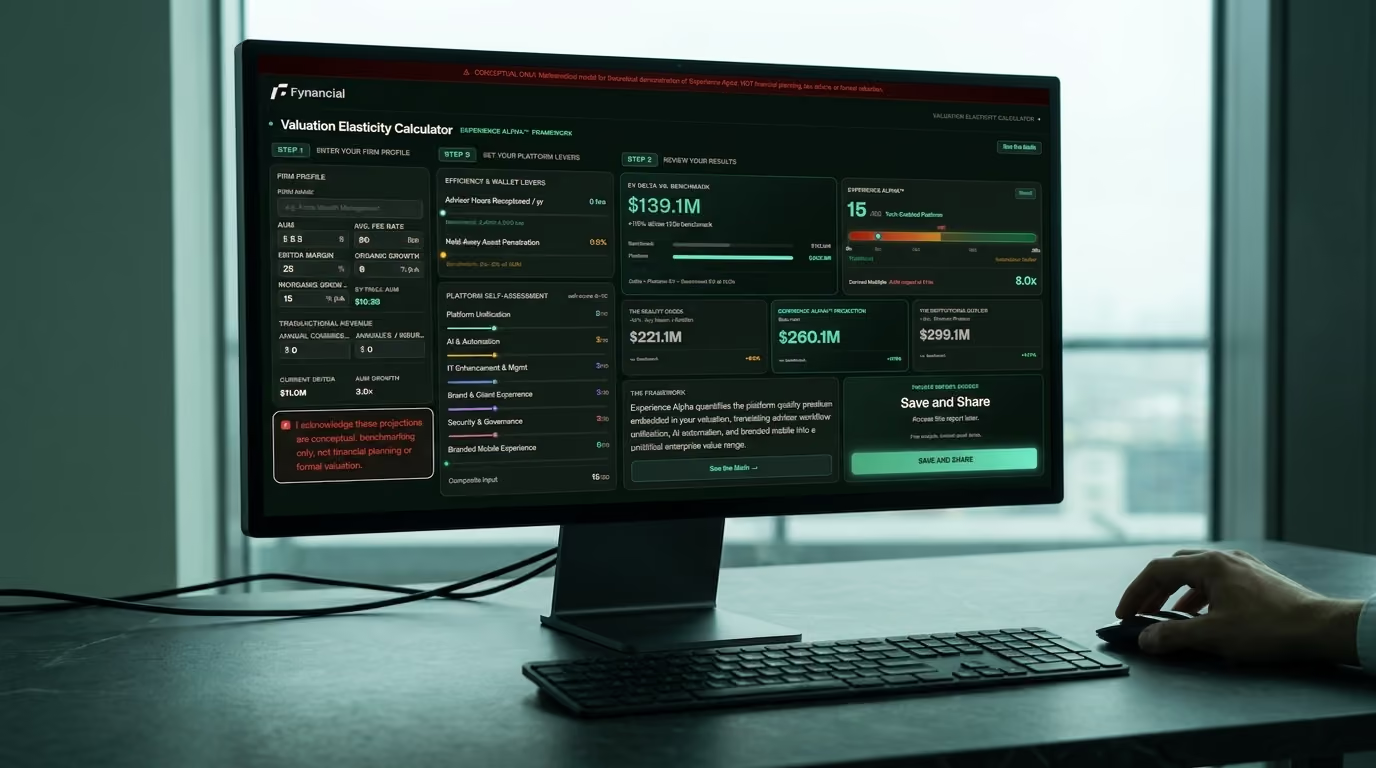
See your Platform Premium in 2 minutes
Model AUM → multiple uplift. Live. Under 2 min.
Enter AUM, headcount, and growth. The calculator maps how a branded client layer can move your valuation multiple, recalculating as you adjust inputs.