Your clients aren't the ones who won't use the app
Tom Fields with Jason Pereira on Fintech Impact, episode 426
This is your brand that you work so hard on going into the pockets of your most important clients.
Jason Pereira has given the same talk to advisors many times. He shows them digital tools their clients could use, and someone always says it: my clients aren't going to use this.
Pereira is the host of Fintech Impact, and he doesn't soften his reply. "Really? Did you survey them? Did you ask them? Did you try?" If your clients have grandkids, he points out, they're on FaceTime with them. "All you're telling me about is your unwillingness to adapt, or your lack of comfort with technology. You're projecting that."
Tom Fields, Founder and CEO of Fynancial, couldn't agree more. Most of the time, the adoption objection belongs to the advisor. Fynancial's view is that a firm waiting for every client to move over will wait forever, and it's waiting for the wrong thing.
A planner who calls this the industry's own goal
Pereira runs a financial planning practice and has hosted more than four hundred episodes of Fintech Impact, so he hears a lot of product pitches from the advisor's side of the desk. He opens this one by putting his own view on record. Ignoring space on the client's phone is, in his words, "one of the single biggest own goals that this industry has ever done." Every other important job in a person's life starts with a little square on the home screen. When the job is talking to your financial advisor, he asks, where do you go?
He also pushes back on the founding story. When Tom says his largest client fired him after six months of silence, Pereira tells him six months is a high bar. "When people say I left them because I never hear from them, we're talking 24 months normally." Tom's client was demanding, and Tom says so. Your best clients usually are.
The red dot gets clients to open the app
Tom's first claim is one most vendors in this space would rather skip. An app that only shows numbers and graphs won't get used. A client might open it when markets are rough, and otherwise it sits there.
What brings clients in is what he calls "the red dot," the push notification. A reminder to upload a tax return. A note after a vacation. A message the Monday after a rough weekend in the markets. Tom says activation spiked on one of those Mondays, because advisors got out in front with a quick message, a blog post or a selfie video saying, in effect, we know you're nervous and we built the plan for this. Clients want to hear from the person they trust with their money, he says, "not clicking Facebook and reading a clickbait article."
The numbers and graphs still matter once clients are in, but they come for the conversation. "Just like we don't email our friends, we text them."
Messaging is a feature, so give clients more than messaging
Pereira raises the issue every compliance officer raises. Firms keep getting fined for client communication on unmonitored channels, and you can't control where a client decides to text you. Tom's answer starts with a concession: "Messaging is just a feature." Give clients a new phone number and they'll keep texting the old one, because the SEC and the fines are the firm's worry.
So the app has to give clients a reason to change the habit. In the same place they can message their advisor, they can see their net worth, upload documents and check off the to-do list from their last meeting. Every message goes back to the client's record in the CRM and into the firm's archiving system. Clients get an easier way to reach their advisor, and the firm gets a record compliance can live with.
Start growth with the clients you already have
Tom repeats a line he uses everywhere: there are two ways to grow a business, make current clients more profitable or win new ones. He tells a story to show how the first one works.
One firm offered a tax-managed strategy that made sense only for clients facing a large liquidity event. Instead of emailing it to a segmented list, they explained how it worked inside the app, and only the clients it fit could see it. One of them messaged his advisor: "This sounds really interesting. I actually have a liquidation event coming up. Can we talk?" He put money in. Seven months later, Tom says, the client still had the $2 million he'd set aside for a tax bill, and his advisor got to tell him he didn't owe it.
For new clients, the move is making referrals easy enough to happen. A client can show a friend the app, the friend scans a code and can book a meeting or see what it feels like to be a client, which beats a stranger talking to a stranger.
This changes how a firm works
Pereira closes with three standard questions, and the second is about the biggest challenge in building the company. Tom gives an answer more vendors should give. "This isn't a technology that you flip on. This isn't a technology that sits in the back. This is your brand that you work so hard on going into the pockets of your most important clients." He also admits onboarding "certainly isn't extremely fast," because the firm's brand has to arrive in clients' hands right the first time.
Those two admissions are the case for doing it. A firm that expects a client app to work like a back-office tool will be disappointed. A firm that treats it as a new way of delivering advice, with advisors who use it and a launch plan behind it, gets the red dot working for it.
Pereira also makes a point principals should take into their next leadership meeting: not every client will move over, and that's fine. “If your adoption rate is meaningful, call it 50 percent, how much better does that make your life?" Tom adds the part most firms miss. New clients have no habits to break. If the app is the first thing a new client sets up, they'll use it, because it's the only way they've ever worked with you.
Make the app part of every new client's first week
Pick a date. From that day, every new client gets the firm's app in their first week, set up in the onboarding meeting with the advisor in the room. Don't wait to convert the existing book first. Track how many of those new clients message their advisor in the first 30 days, then show that number to the advisors who said clients won't use it.
The conversation in short
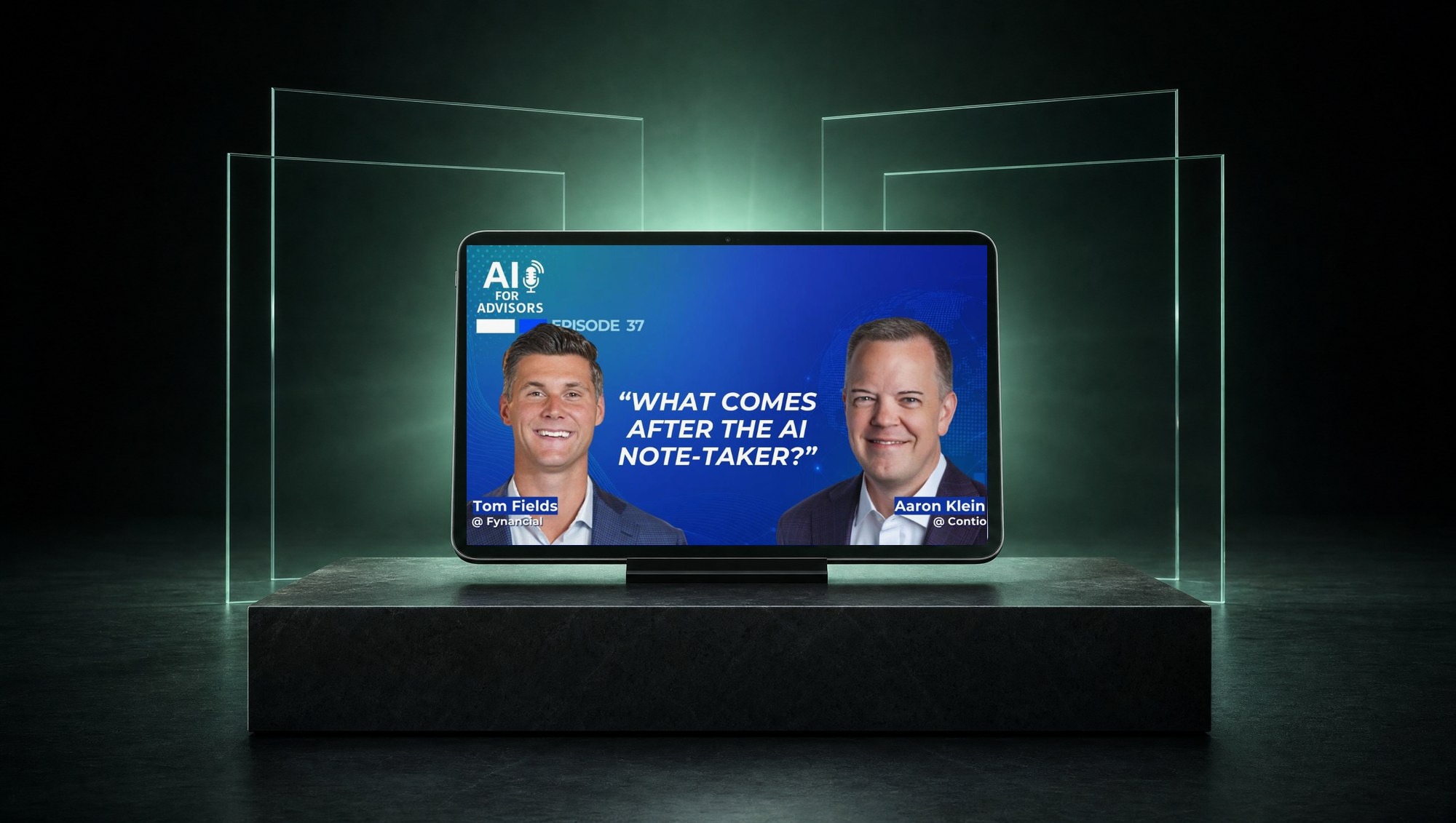
Pereira introduces Fynancial as a way for firms to own space on the client's phone. Tom tells the story of being fired by his largest client over six months of silence, and Pereira points out that most clients wait far longer before they leave. Tom explains what he did next: he looked at his firm's website full of separate links and logins, and went looking for a white-labeled, integrated app with messaging that didn't exist. They talk about what makes clients open an app, how advisors use push notifications when markets move, and how messaging stays compliant through the CRM and archiving integrations. Tom shares how firms grow wallet share and referrals. Then they get into AI, data and delivery, and next best action for advisors with a human in the loop. Pereira closes with his three questions.
Key moments
Chapter markers as published by Fintech Impact.
00:49 What Fynancial does
01:24 Why advisors need real estate on the phone
02:14 The origin story, the client who fired him
05:01 Building the advisor app
06:25 Client engagement and push notifications
09:44 Compliance and secure messaging
12:03 Success stories, growth and referrals
16:25 Future roadmap, AI and next best action
19:20 Rapid fire closing questions
23:41 Wrap up
Listen
Fintech Impact, episode 426, "Fynancial with Tom Fields," hosted by Jason Pereira. Published May 5, 2026. Runtime 24:31.
YouTube: https://www.youtube.com/watch?v=4sv38cFRIEw
Spotify: https://open.spotify.com/episode/13X9UVSLlLICTu0AzXPNPB
Apple Podcasts: https://podcasts.apple.com/us/podcast/fynancial-with-tom-fields-e426/id1359909626?i=1000766212686
Acast: https://shows.acast.com/fintechimpact/episodes/fynancial-with-tom-fields-e426
Nathaniel Stout is Head of Media at Fynancial and a U.S. Air Force combat camera veteran. He leads brand messaging, content strategy and video production, and edits the Fynancial blog.
Related Insights




What firms say after launching with Fynancial
I am not exaggerating when I say our app has helped us win over $10M in new AUM between two separate prospects. The vision Fynancial has is incredible!

This highly personalized communication solution enables us to connect with clients like never before. Delivering real advice from real advisors with authentic, timely, human-centered guidance.
The Prime Capital app is our all-in-one hub. Seamless advisor to client communication, fully integrated with our core tech stack. The Salesforce integration ties it all together perfectly.

We are currently managing the majority of our client relationships daily through our app. It has been a game-changer, and I cannot say enough positive things about Fynancial and their entire team.

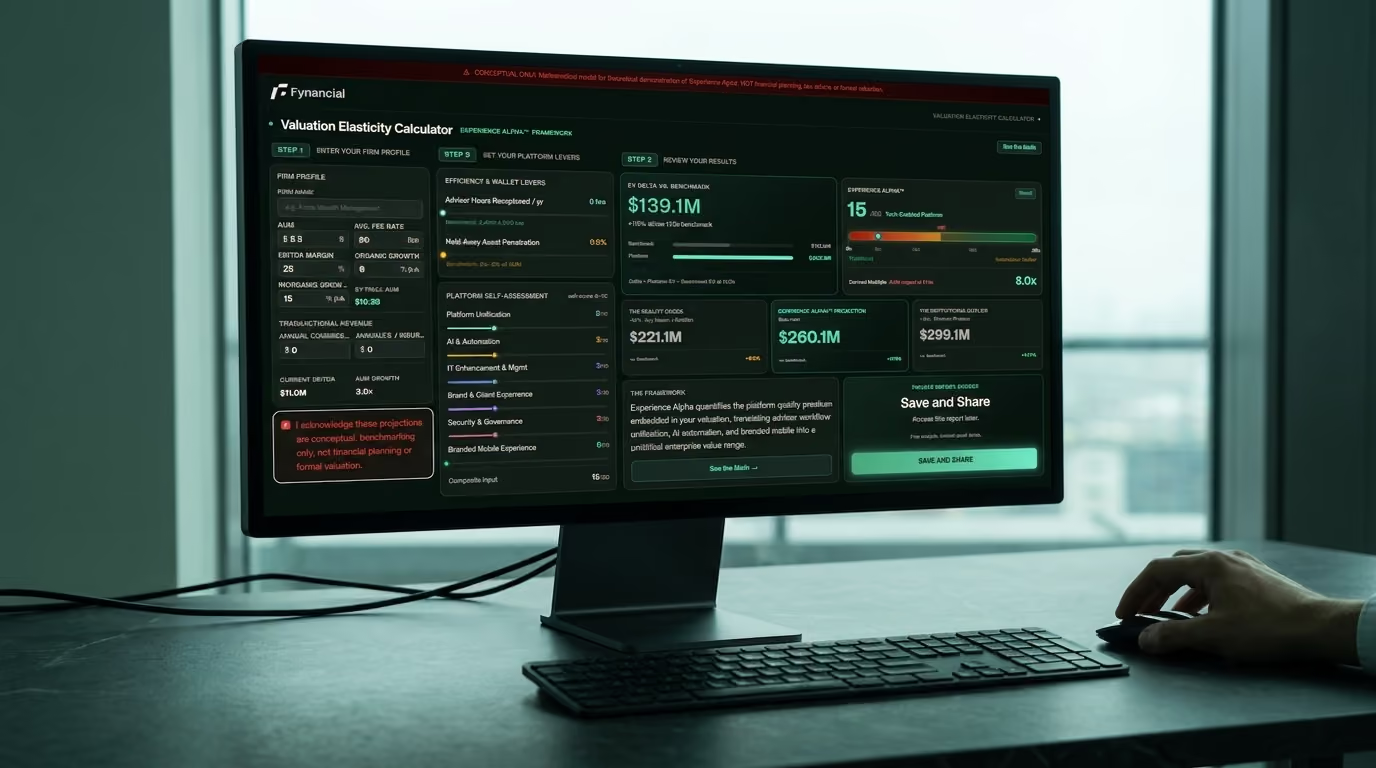
See your Platform Premium in 2 minutes
Model AUM → multiple uplift. Live. Under 2 min.
Enter AUM, headcount, and growth. The calculator maps how a branded client layer can move your valuation multiple, recalculating as you adjust inputs.