Standardizing the Client Experience Across an Acquired Portfolio

The most preventable source of value destruction in wealth management M&A.
Every wealth management acquisition creates an integration problem that most deal teams do not fully model until after close: what does the acquired firm's client experience look like on Day One?
The clients of the acquired firm wake up the morning after the transaction announcement knowing that something has changed, the name, the ownership, potentially the advisor relationships they have built over years. What they are looking for, immediately, is evidence that the change is going to be good for them.
What they usually find is a fragmented, inconsistent, improvised communication experience that undermines the very value proposition that made the acquisition worth making.
This is not an inevitable outcome. It is an architectural choice.
The Hidden Cost of Day-One Communication Chaos
The integration period, typically the 90 days following transaction announcement, is the highest-risk window for client attrition in any wealth management acquisition. Clients are evaluating whether to stay. Competing advisors and vendors are actively recruiting. The relationships that drove the acquisition's valuation are being tested.
The standard playbook for managing this period involves a series of advisor-by-advisor phone calls, a letter from the new parent entity, perhaps a webinar, and an eventual account re-papering process that requires clients to complete forms they do not fully understand for an outcome they did not choose.
This approach has several well-documented failure modes:
Inconsistency across the advisor population. Different advisors communicate the transition differently. Some are enthusiastic advocates for the acquiring entity. Others are privately nervous about their own role and communicate that uncertainty, intentionally or not, to clients. Clients of the same firm have different information and different impressions of the change based solely on which advisor they happen to have.
The missing digital anchor. In modern client relationships, the between-meeting experience is primarily digital. During a period of elevated uncertainty, clients reach for their phones. What they find is a traditional portals that has not changed, a planning tool branded by a third party, and no visible evidence that the acquiring firm has invested in their experience. The absence of a branded digital presence in this moment is read as a signal: the new firm cares less, not more.
Re-papering as an attrition event. The account re-papering process is often the first active request the acquired client receives from the new firm. "Please complete these forms" is not a compelling opening to a new relationship. For clients who were already uncertain about the transition, the administrative burden of re-papering is an inflection point, the moment when switching to a competitor moves from a background consideration to an active plan.
The measurable outcome of poorly managed Day-One transitions is an attrition rate in the 12 to 18 months following close that consistently exceeds the attrition rate modeled by the acquisition underwriting team. Industry data suggests that post-merger attrition in the absence of a structured client experience integration program can reach 12% to 18% of acquired AUM in the first two years.
For a $1B acquisition, that is $120M to $180M in AUM that leaves, against a thesis that assumed 95% retention.
What Day-One Deployment Actually Requires
The Day-One standard, deploying a unified client experience for acquired clients on the day of transaction announcement, or within 30 days of close, is achievable, but it requires three things that most acquiring firms are not prepared for before they begin the integration process:
A pre-configured platform that can be deployed to a new population without bespoke development. If the acquiring firm's client experience infrastructure requires months of configuration for each new set of clients, Day-One deployment is not possible. The platform architecture must allow for rapid population provisioning, new advisors, new clients, new entity branding, without extended technical implementation timelines.
A digital communication that introduces the new brand experience before clients are asked to do anything. The first contact with acquired clients should be a demonstration of investment, not a request for compliance. A branded mobile app invite, "Your new Pinnacle Wealth app is ready", is a fundamentally different message than a re-papering packet. It communicates care, investment, and continuity. It gives clients a positive first interaction with the new entity before the administrative necessities arrive.
Pre-built integration with the acquiring firm's data infrastructure. The acquired clients' account data, performance history, and planning relationships need to be accessible within the new platform from Day One, not populated over weeks as data migration teams work through backlogs. This requires the client experience platform to be integrated with the acquiring firm's full technology stack at the data layer, not just the presentation layer.
Fynancial's M&A Day-One Integration Playbook was built specifically around these requirements. It is the product of working through enterprise deployments with firms including Wealth Enhancement Group ($143.8B AUM) and other national RIAs that complete multiple acquisitions per year.
The Compounding Value of Standardization
For serial acquirers, firms that are executing three, five, or more transactions per year, the Day-One deployment capability is not just a risk management tool. It is a competitive advantage in the acquisition market itself.
Advisory firm principals who are evaluating exit options are not choosing solely on price. They are choosing on post-close operational continuity, on the confidence that their clients will be well-served, and on the protection of the advisor relationships they have spent careers building.
A serial acquirer that can demonstrate a documented, repeatable Day-One integration protocol, "here is exactly what happens for your clients on the day we announce, and here is what it has looked like for the five firms we have acquired in the past 18 months", wins transactions against higher-priced offers from acquirers who cannot make that case.
The firms in the Fynancial enterprise client portfolio are using this exact capability as a differentiator in the acquisition market: the ability to show a target firm's principal an actual version of the app their clients will use, branded with their firm's identity, with a deployment timeline that begins at announcement rather than months after close.
This is the compounding value of standardization: it reduces integration risk, accelerates value realization, and improves acquisition sourcing simultaneously.
The Build vs. Buy Question
For firms that are building an acquisition strategy for the first time, the Day-One deployment question often surfaces as a build-vs-buy decision. Should the firm build a proprietary client experience platform, one that is fully owned, fully customized, and not dependent on a third-party vendor, or should it deploy a purpose-built enterprise platform that has already solved this problem?
The build option is almost uniformly the wrong answer for firms that are not themselves technology companies. The development cost, the maintenance burden, the compliance certification requirements (SOC 2 Type II, ISO 27001), the App Store and Google Play publication and maintenance, and the ongoing feature development that client expectations demand, these are not marginal technology investments. They are material operational commitments that distract from the core business of delivering wealth management advice.
The firms that have tried to build have generally spent 18 to 36 months and $2M to $5M before concluding that the maintenance burden alone is unsustainable. The firms that have deployed purpose-built enterprise platforms have had production-ready, fully branded client experiences within 60 to 90 days of contract execution.
The Day-One deployment standard is not a goal. It is a capability. Whether your firm has it is a function of your architecture.
Learn About M&A Day-One Integration →
Explore the Salesforce Managed Package →
Book an Experience Alpha Audit →
The Fynancial Insights team writes on enterprise value, client experience architecture, and the platform decisions that shape valuation for independent advisory firms.
Related Insights





What firms say after launching with Fynancial
I am not exaggerating when I say our app has helped us win over $10M in new AUM between two separate prospects. The vision Fynancial has is incredible!

This highly personalized communication solution enables us to connect with clients like never before. Delivering real advice from real advisors with authentic, timely, human-centered guidance.

The Prime Capital app is our all-in-one hub. Seamless advisor to client communication, fully integrated with our core tech stack. The Salesforce integration ties it all together perfectly.

We are currently managing the majority of our client relationships daily through our app. It has been a game-changer, and I cannot say enough positive things about Fynancial and their entire team.

See your Platform Premium in 2 minutes
Model AUM → multiple uplift. Live. Under 2 min.
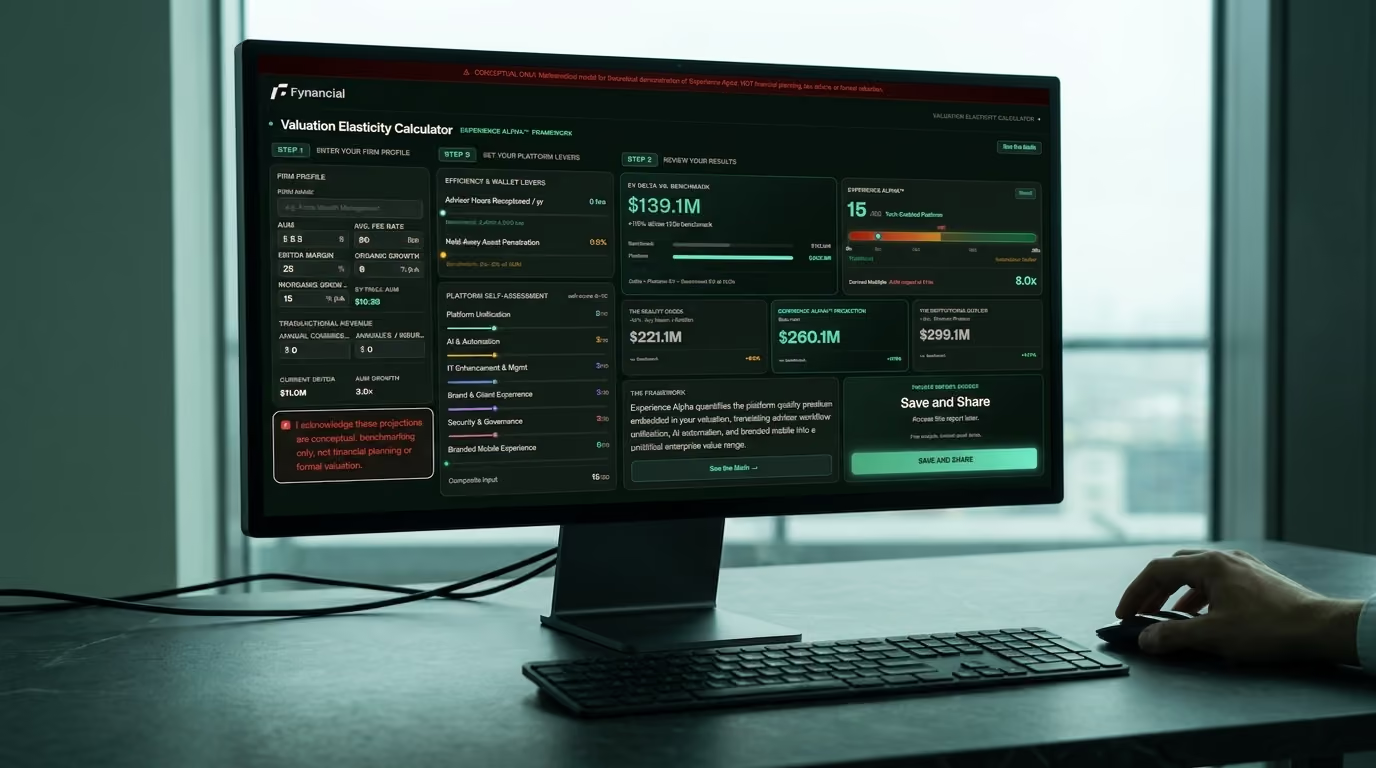
Enter AUM, headcount, and growth. The calculator maps how a branded client layer can move your valuation multiple, recalculating as you adjust inputs.