Recording the meeting was never the hard part
Aaron Klein and Tom Fields on why note-taking solved the easy half of the problem
Email is the number one thing that's holding this industry back.
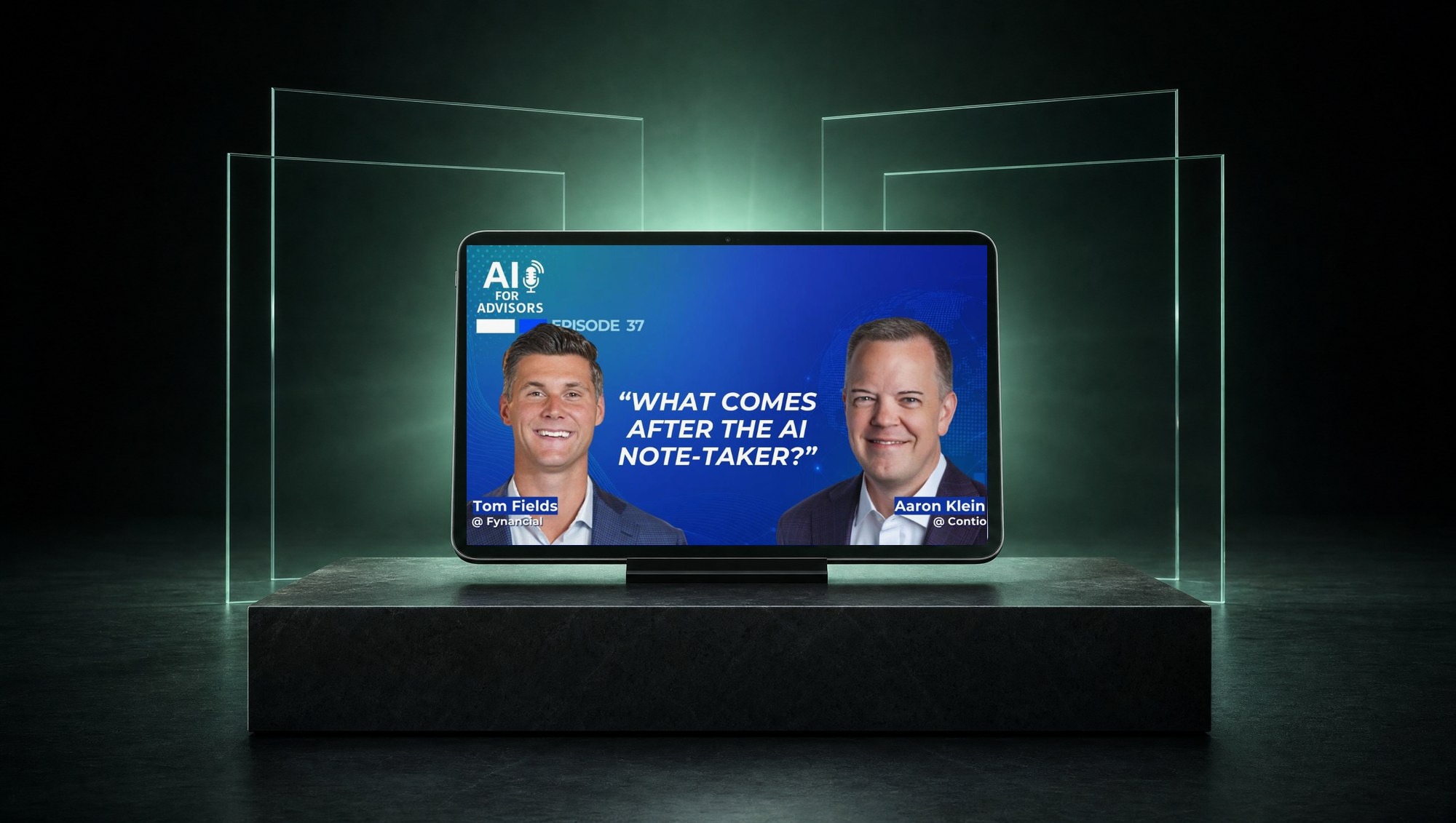
Almost every advisory firm now runs an AI note-taker. Retention numbers have not moved. On this episode of AI for Advisors, hosts Mark Heynen and James Cantwell put that contradiction to Aaron Klein, who spent twelve years building Riskalyze into a category before starting over with Contio, and to Tom Fields, Founder and CEO of Fynancial.
Klein's answer sets up the hour: the note-taker wave started at the wrong end of the problem. Capture was never the bottleneck. Turning what gets said in a meeting into what actually gets done is the job, and almost nobody has built for that half.
Fynancial is the first partner platform built on Contio's MeetingOS, so the two of them spend the episode working through what that looks like in practice for an advisor.
What Tom and Aaron actually argue
Note-taking solved the easy half.
Klein's position is that the industry rushed to automate transcription because transcription is tractable. The follow-through, the decisions, the client actually doing the thing they agreed to do, all of that sits downstream and untouched.
An operating system is not a platform, and the difference matters.
Klein is pointed about this. He objects to how the industry uses the word platform to mean maximizing minutes inside a product, which is the metric Riskalyze itself optimized for. Contio is built as a layer other companies build on top of, which is why Fynancial can sit above it rather than compete with it.
Output data is not a moat.
Klein says he will not buy from firms that fail to give a customer clear API or MCP access to that customer's own data. Locking data up looks defensible for a quarter or two and loses you the account.
Review meetings are worth attacking.
Klein's framing is that the annual review is a poor decision-making tool that survives because it is a decent relationship-building tool. Those are two different jobs and the industry keeps confusing them.
Tom's case starts with getting fired.
He lost his largest client, roughly 13% of his book, over six months of silence. Not bad performance. Silence. That is the origin of the company and he tells it straight.
Email is the thing he keeps coming back to.
Tom calls it the number one thing holding the industry back. His argument is not that email is annoying, it is that email is a channel the advisor does not control, competing with everything else in an inbox, which makes proactive communication structurally unreliable.
A task is not an action item.
Tom draws a line between a task, which is a CRM object that belongs to the advisor, and an action item, which is a to-do list the client can actually see. He cites a $700K rollover that closed the same evening after two years of asking, once the request became something the client could see and act on.
The 78-year-old client.
Tom describes a client in his late seventies who asked, unprompted, for an app, high-level numbers, a way to message the team, and Face ID. Fynancial's own device data lines up with it: phone first, iPad second, desktop last.
Firms keep trying to build this themselves.
Tom says he has watched firms spend $300K to $500K building their own client app without reaching production, and he has yet to hear a success story.
Prep belongs a week or two out, not thirty minutes before.
Both of them land here. Speed of response is a relationship advantage, not just an efficiency one.
The rapid-fire close.
Klein's overrated pick is the non-software company that decides to build all of its own software. His underrated pick is the firm that builds its own connective work between best of breed tools. He calls this the Apple II era of AI.
Why this one is worth the full hour
Most AI conversations in wealth management stay at the level of what the tools can do. This one is about sequencing: which problem you solve first, and what happens when the whole industry solves the same easy one at the same time.
Listen to the episode
AI for Advisors, "What Comes After the AI Note-Taker: Aaron Klein @ Contio, Tom Fields @ Fynancial." Hosted by Mark Heynen and James Cantwell, published August 20, 2026.
Apple Podcasts: https://podcasts.apple.com/us/podcast/what-comes-after-the-ai-note-taker-aaron-klein-contio/id1868295133?i=1000784502704
Spotify: https://open.spotify.com/episode/1O8k7iJQQMNX89dJXdbgX2
Nathaniel Stout is Head of Media at Fynancial and a U.S. Air Force combat camera veteran. He leads brand messaging, content strategy and video production, and edits the Fynancial blog.
Related Insights




What firms say after launching with Fynancial
I am not exaggerating when I say our app has helped us win over $10M in new AUM between two separate prospects. The vision Fynancial has is incredible!
This highly personalized communication solution enables us to connect with clients like never before. Delivering real advice from real advisors with authentic, timely, human-centered guidance.
The Prime Capital app is our all-in-one hub. Seamless advisor to client communication, fully integrated with our core tech stack. The Salesforce integration ties it all together perfectly.

We are currently managing the majority of our client relationships daily through our app. It has been a game-changer, and I cannot say enough positive things about Fynancial and their entire team.

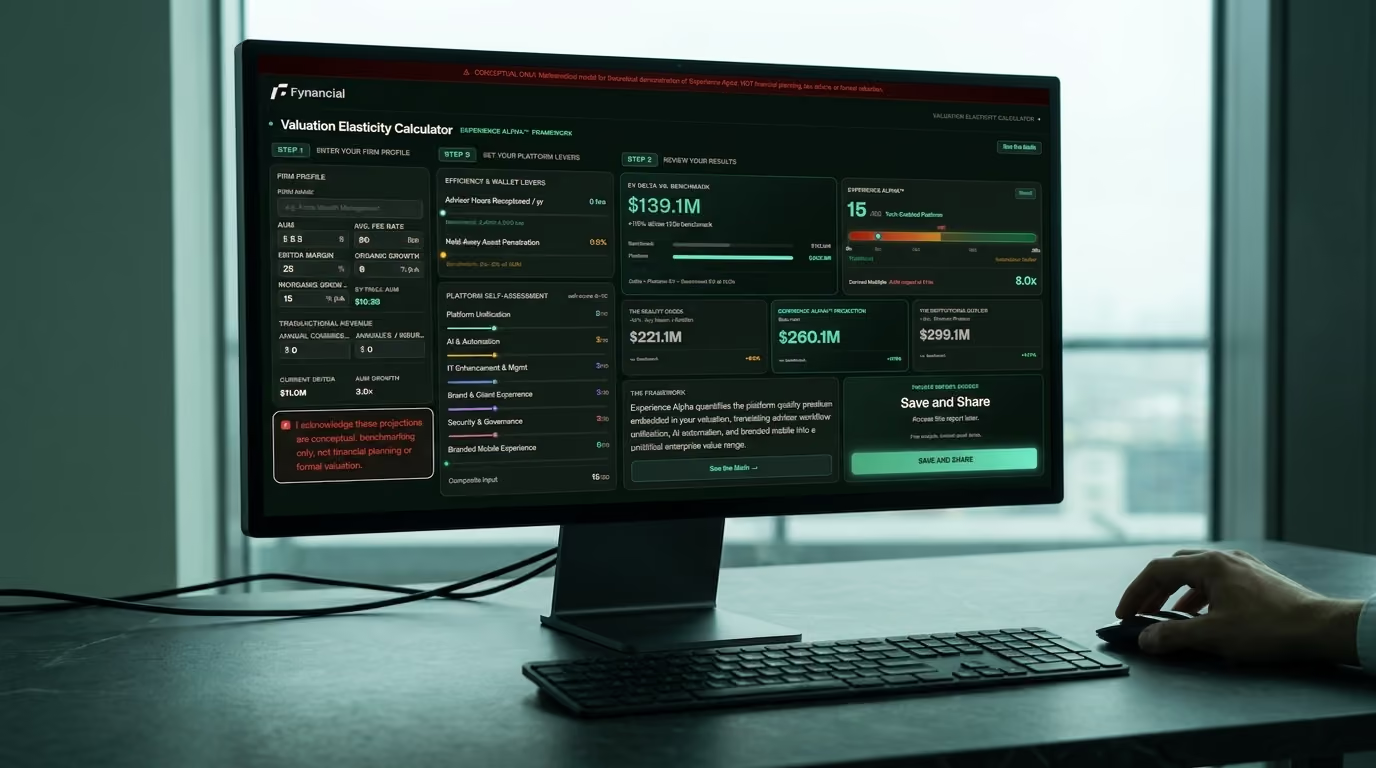
See your Platform Premium in 2 minutes
Model AUM → multiple uplift. Live. Under 2 min.
Enter AUM, headcount, and growth. The calculator maps how a branded client layer can move your valuation multiple, recalculating as you adjust inputs.