The Post-Merger Integration Premium: Why Operational Architecture Is the Most Expensive Line Item You're Not Pricing Into Your Acquisitions

The true cost of inheriting fragmented technology never shows up in the QoE.
The pitch book looked perfect. $800M in AUM. 87% client retention over five years. A strong team with deep local relationships. Reasonable purchase price.
Eighteen months later, the integration is still not complete. Two key advisors have left. Client attrition is running above the modeled assumptions. The technology remediation project, which the deal team estimated at $400K, is approaching $2M.
This is the post-merger integration trap. And it is the most common place where RIA acquisitions fail to deliver the expected return.
The Hidden Costs Nobody Models Properly
Most RIA acquisition models have a line for "integration costs." It is typically a rough estimate, 2–5% of the deal value, sometimes less. What it almost never captures is the true cost of technology fragmentation.
The data migration cost. Extracting client data from a legacy CRM, cleaning it, transforming it to fit your standard data model, and loading it into your system of record takes longer and costs more than any pre-deal estimate suggests. When that CRM also has custom objects, unique workflow configurations, and years of unstructured notes, multiply the estimate by three.
The client experience disruption cost. During the migration, clients get mixed communications. Some come from the legacy system. Some come from the new platform. The experience is inconsistent. In a $5M client relationship, "inconsistent experience during our transition" is a meaningful attrition trigger.
The advisor adoption cost. Every new system your acquired advisors have to learn represents productivity loss and departure risk. Senior advisors who have been running their practice on the same tools for 15 years are not enthusiastic about technology migrations. If the new platform is materially worse than what they left, in terms of client-facing quality, they will leave.
The compliance remediation cost. If the acquired firm was not archiving communications to the standard you require, the remediation project involves both technology implementation and retroactive documentation. Neither is cheap.
What the Best Aggregators Do Differently
The most successful RIA roll-up operators have learned to solve this problem architecturally rather than operationally.
The insight is straightforward: if you separate the client-facing experience from the back-office systems, you can standardize the front end on Day 1 without touching the legacy back-end systems.
A branded mobile client experience platform, deployed on Day 1 of every acquisition, immediately gives acquired clients a premium, consistent experience under the acquiring firm's brand. The legacy CRM keeps running. The legacy reporting system keeps running. The client never experiences a disruption.
The back-end migration then becomes an operational project that can be managed at the appropriate pace, with appropriate resources, without any client-facing risk. The integration tax is paid in back-office time, not in client attrition.
The Day-1 Deployment Principle
The firms commanding the highest multiples in roll-up transactions are not the ones with the cleanest back offices. They are the ones with the most institutionalized client-facing experience.
Institutional buyers understand that back-office systems can be migrated. What cannot be easily recaptured is client trust that was eroded during a poor integration experience.
The Day-1 deployment principle is simple: the moment an acquisition closes, every client of the acquired firm should be experiencing the acquirer's brand, the acquirer's communication standards, and the acquirer's digital quality. Not in six months. Not after the CRM migration. On Day 1.
This requires a client experience platform that is architected as an overlay, a layer that sits on top of whatever back-end systems exist, connects to them via APIs, and delivers a consistent branded experience regardless of what is happening in the back office.
Pricing the Integration Premium Into Your Models
For firms that are thinking about technology architecture from the buy side, here is a simple framework for pricing integration risk:
Green flag (lower integration discount): Target firm has a unified client-facing platform with measurable adoption data. Back-end systems may vary but the client experience layer is institutionalized.
Yellow flag (moderate integration discount): Target firm has a consistent CRM but relies on traditional portals for client-facing experience. Migration is a back-end project with limited client-facing risk.
Red flag (higher integration discount): Target firm has a Frankenstack, multiple disconnected systems, advisor-managed client communications, no unified client-facing identity. Every integration dollar estimate you have built is too low.
The Platform Premium is real. And so is the Frankenstack discount. Price both accordingly.
Preparing for an acquisition or a capital raise? Download the Experience Alpha Enterprise Blueprint →
The Fynancial Insights team writes on enterprise value, client experience architecture, and the platform decisions that shape valuation for independent advisory firms.
Related Insights





What firms say after launching with Fynancial
I am not exaggerating when I say our app has helped us win over $10M in new AUM between two separate prospects. The vision Fynancial has is incredible!

This highly personalized communication solution enables us to connect with clients like never before. Delivering real advice from real advisors with authentic, timely, human-centered guidance.

The Prime Capital app is our all-in-one hub. Seamless advisor to client communication, fully integrated with our core tech stack. The Salesforce integration ties it all together perfectly.

We are currently managing the majority of our client relationships daily through our app. It has been a game-changer, and I cannot say enough positive things about Fynancial and their entire team.

See your Platform Premium in 2 minutes
Model AUM → multiple uplift. Live. Under 2 min.
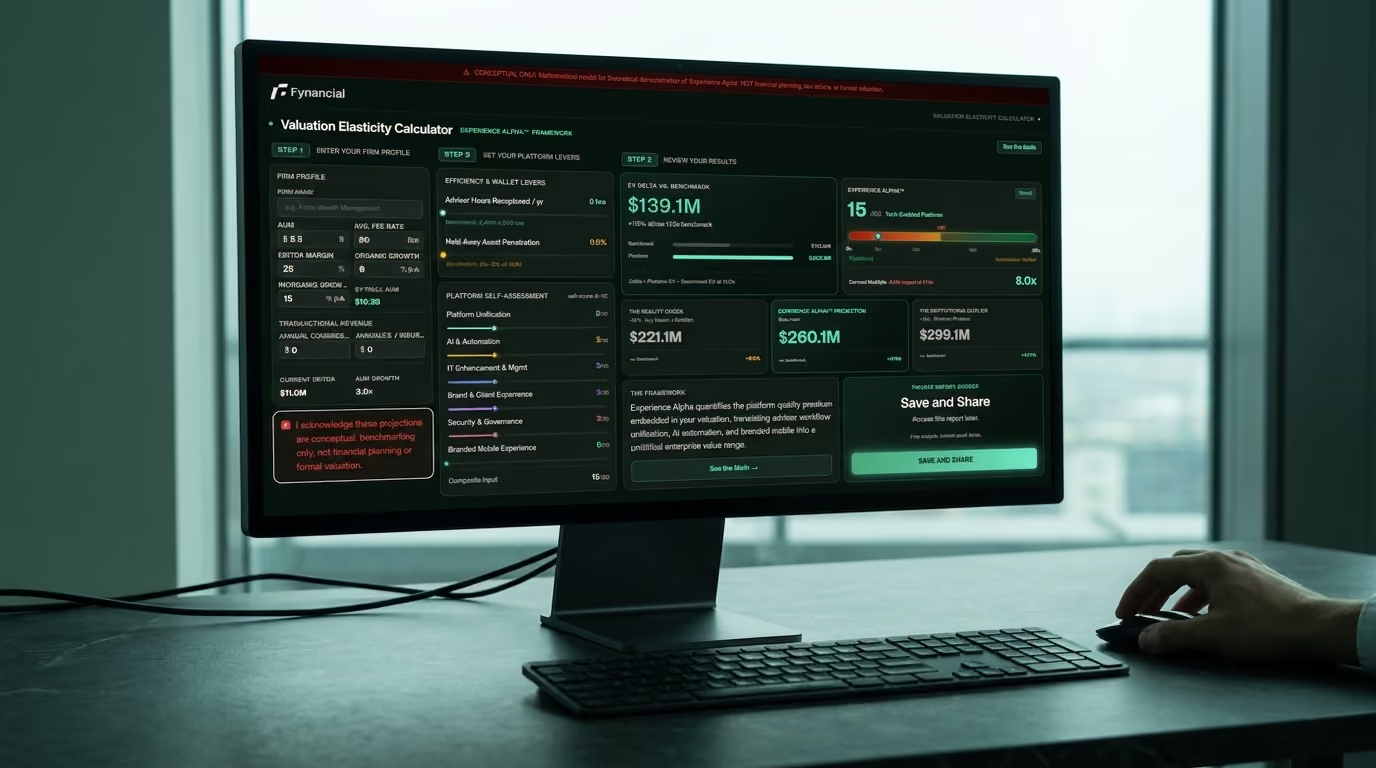
Enter AUM, headcount, and growth. The calculator maps how a branded client layer can move your valuation multiple, recalculating as you adjust inputs.