When a Client Says 'Lack of Communication,' They Almost Never Mean Frequency

The most common reason a client leaves an advisor is some version of "they didn't communicate with me." Every principal reading this has seen it in an exit conversation, and almost every firm draws the wrong conclusion from it. The instinct is to add volume. More emails. Another quarterly call. A monthly newsletter, a market commentary, a holiday card. The firm treats communication as a quantity problem and turns up the output.
It rarely works, because the client was almost never complaining about quantity. They were telling you that nothing you sent actually reached them. The problem was the channel, not the cadence, and no amount of additional volume fixes a channel the client does not experience.
I learned this the hard way, on a day I was communicating more than I ever had in my career.
The Metrics Firms Track Measure Activity, Not Communication
Back in 2019 I was an advisor running a financial education program on the side, delivered through a branded app. The people in it were engaged daily. They opened the app, did the work, and talked to me constantly. It was the highest-touch stretch of my career. In the middle of it, a client fired me for lack of communication. It was 13% of my book, and it did not compute until much later.
Here is what it taught me. The things firms count as communication, statements delivered, reviews held, emails sent, are measures of activity. They are not measures of whether anything was received. A statement that lands in an inbox the client never opens did not communicate anything. A quarterly review the client sits through and forgets by dinner barely did. Communication is only the part the client takes in and retains, and most of what a firm sends never clears that bar. The dashboard says you are communicating. The client says you are not. They are both right, because they are measuring different things.
The Math of Attention
Look at the actual cadence of a wealth relationship. A client meets their advisor two or three times a year. For the 360-plus days in between, they experience their financial life through whatever interface happens to be in front of them, and for most firms that interface belongs to someone else. A traditional portals with a competitor's name on it. A performance reporting tool branded to the vendor. An advisor's personal email, sitting in an inbox next to a few hundred other unread messages.
None of those are neutral. Each one is a place where the client's attention already lives, and none of them carry your firm. So when you send more into those channels, you are not increasing communication. You are increasing the volume of things the client can ignore, and you are doing it in an environment where ignoring you is the default.
That is why frequency is the wrong lever. You can triple your output and still lose the client who told you that you never reached them, because you added more sends to a channel that was never landing in the first place.
The Complaint Is a Retention Signal, Not a Volume Signal
Firms consistently misread the communication complaint at exit, and the misread is expensive. When a departing client says communication was the issue, the honest translation is usually: my financial life did not feel connected to your firm between the meetings. The competitor who won them did not necessarily meet with them more. They occupied more of the client's attention, on a channel the client actually checked.
This is also why the complaint tends to surface at the worst possible moments: a market scare, a liquidity event, an inheritance. Those are the moments a client reaches for their phone, and if what they find there is not you, the relationship was already thinner than the review calendar suggested.
What to Audit Instead
The useful question is not "are we communicating enough?" It is "is what we send being received, on a surface the client already uses, under our name?" A firm that wants an honest answer looks at whether it can even see client engagement, whose brand is on the interface the client opens between meetings, and whether the client experiences the firm at all in the 360 days when nobody is sitting across a table from them.
The simplest version of the test is the one I still use. Ask a client to open their phone and check their financial picture right now. Whose brand are they looking at? If it is a vendor or a reporting vendor, you do not have a communication problem you can solve by sending more. You have a channel problem, and the client will keep telling you it is about communication until you fix where the communication lands.
Adding touchpoints to a channel the client does not experience is just paying more to be ignored with greater precision. The firms that win this do not get louder. They move to the surface the client already checks every day, and they make it their own.
Tom co-founded Fynancial on the thesis that the gap between the quality of independent advice and the digital experience used to deliver it is one of the most addressable problems in wealth management. He leads product vision, enterprise partnerships, and the Experience Alpha framework.
Related Insights





What firms say after launching with Fynancial
I am not exaggerating when I say our app has helped us win over $10M in new AUM between two separate prospects. The vision Fynancial has is incredible!

This highly personalized communication solution enables us to connect with clients like never before. Delivering real advice from real advisors with authentic, timely, human-centered guidance.

The Prime Capital app is our all-in-one hub. Seamless advisor to client communication, fully integrated with our core tech stack. The Salesforce integration ties it all together perfectly.

We are currently managing the majority of our client relationships daily through our app. It has been a game-changer, and I cannot say enough positive things about Fynancial and their entire team.

See your Platform Premium in 2 minutes
Model AUM → multiple uplift. Live. Under 2 min.
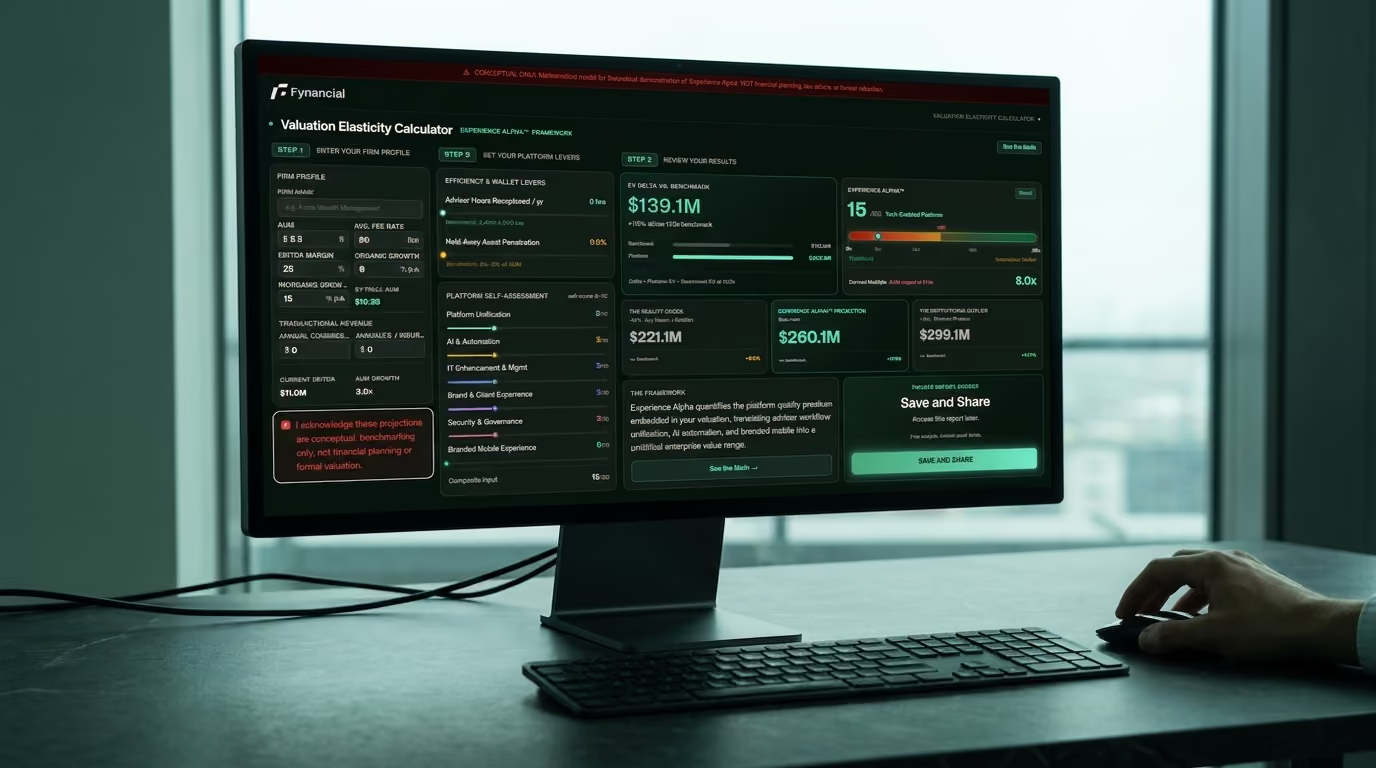
Enter AUM, headcount, and growth. The calculator maps how a branded client layer can move your valuation multiple, recalculating as you adjust inputs.