The Infrastructure Gap Is Now a Valuation Gap

The firms that understand this are building accordingly.
In the mid-2010s, private equity discovered the home services industry.
Plumbing. HVAC. Electrical. Pest control. Landscaping. These were fragmented industries dominated by local owner-operators: small firms with loyal customer bases, strong cash flow, and virtually no scalable operating infrastructure. Each firm's value was tied to the owner who ran it: the master plumber who showed up on time, the HVAC technician who called clients back, the landscaper who knew which houses had sprinkler systems that froze every winter.
PE sponsors looked at this market and saw a pattern they recognized: fragmented local businesses with recurring revenue models, underserved by technology, dependent on key-person relationships, and ripe for consolidation under standardized operating platforms.
The thesis was straightforward. Buy thirty local HVAC companies. Install a common dispatch platform, a common CRM, a common customer-facing mobile app. Convert thirty key-person-dependent businesses into one scaled, brand-driven, technology-enabled platform. Capture the multiple expansion from moving up the institutional quality curve. Exit at 14x to 16x EBITDA what was acquired at 4x to 6x.
That thesis executed. The home services consolidation playbook created billions in enterprise value for the sponsors who ran it. And it left behind something instructive for wealth management: a clear map of what happens when PE capital meets fragmented, key-person-dependent, relationship-driven service businesses that have not invested in their operational infrastructure.
The Parallel Is Exact
The structural features that made home services attractive for PE consolidation are present in independent wealth management in almost identical form:
Recurring revenue with strong retention. Wealth management generates fee-based recurring revenue with historically high client retention rates. This is the same profile that attracted PE to HVAC subscriptions and pest control agreements.
Fragmentation. The independent advisory market is deeply fragmented, with thousands of firms operating at regional and local scale, many of which have never needed to compete on operational excellence because their markets were underserved.
Key-person dependency. Advisory firm value is concentrated in advisor relationships. That concentration creates both risk and acquisition opportunity, in exactly the same way that the master plumber's value was.
Underinvestment in technology. Most advisory firms have invested in performance reporting and planning tools that serve the advisor workflow, but have not invested in the client-facing infrastructure that would make the firm's brand and service model visible and scalable beyond individual advisor relationships.
Succession gap. An enormous percentage of advisory firm principals are within 10 to 20 years of retirement, with no clear succession plan. PE sponsors are buying that succession premium every week.
The PE consolidation of wealth management began in earnest around 2018 and has not slowed. The firms doing the acquiring have applied the playbook. The question for independent RIA principals is whether they are on the right side of it.
What the Playbook Looks Like From Inside the Target
For advisory firm principals, understanding the PE wealth management consolidation thesis from the acquirer's perspective changes the strategic options calculus significantly.
When PE sponsors evaluate wealth management acquisitions, they are not primarily evaluating AUM. AUM is the starting point. They are evaluating the platform infrastructure that will allow them to unlock the multiple expansion by moving the acquired firm up the institutional quality curve.
The question they are asking is: how much does it cost to install the institutional operating platform on top of this business?
Firms that have already built the institutional operating platform, unified client experience, governed AI capabilities, native compliance archival, enterprise CRM integration, are acquired differently than firms that have not. The platform infrastructure is either already there, in which case the integration cost is lower and the Day-One operational quality is higher, or it has to be installed post-acquisition, in which case the acquirer prices the installation cost, the integration risk, and the attrition risk during the transition period into the acquisition price.
The infrastructure gap is priced into the transaction: either as a premium paid to the firm that built it, or as a discount applied to the firm that did not.
The Bifurcation That Mirrors Home Services
What happened in home services after PE consolidation is instructive. The market bifurcated: large, technology-enabled platform companies commanding premium multiples and reinvesting aggressively in platform development versus small, owner-operated businesses competing on local relationships and price, slowly losing market share, unable to match the marketing spend and service consistency of the platforms, ultimately either selling at distressed multiples or exiting the market.
The same bifurcation is occurring in wealth management, and the timeline is accelerating.
The consolidators (Wealth Enhancement Group, Mercer Advisors, Cetera, Focus Financial, Dynasty Financial, and a dozen PE-backed platforms) are not acquiring every firm. They are acquiring firms with institutional infrastructure that can be integrated into their platform efficiently, and passing on firms that require expensive remediation before integration can begin.
Independent firms that have invested in their client experience infrastructure are becoming more attractive acquisition targets, commanding premium multiples, and retaining strategic optionality: the ability to choose their exit path rather than being forced to accept whatever terms the market offers.
Independent firms that have not invested are becoming less attractive, more dependent on individual advisor relationships for valuation support, and increasingly positioned as targets for distressed or discounted acquisition.
The Strategic Response
Understanding the PE consolidation thesis does not require a firm to pursue a sale. It requires a firm to understand the market dynamics that are reshaping valuations and to build accordingly.
For firms that intend to remain independent and build multi-generational advisory practices that pass to the next generation of advisors or to the founders' children, the PE thesis is still instructive. The investments that consolidators require in acquisition targets are the same investments that make a firm viable as an independent institution: branded client experience, governed technology infrastructure, AI capabilities, compliance architecture.
A firm that has built the institutional operating platform is not just a better acquisition target. It is a better business. It retains clients at higher rates. It grows organically at higher rates. It attracts better advisor talent. It achieves better economics at scale.
The infrastructure gap is a valuation gap in both directions: in M&A transactions and in the ongoing competitive market.
For firms with $1B to $10B in AUM that are thinking seriously about the next 10 years, whether the path leads to an M&A event, a PE partnership, a generational succession, or continued independence, the infrastructure decision is the same: build the client experience layer that makes your firm institutional-grade, and build it before the market prices the gap.
Made for This Moment
Fynancial was built for the independent RIAs that are navigating this consolidation with intention, building the institutional infrastructure that preserves their strategic optionality and maximizes their enterprise value regardless of the path they ultimately choose.
The firms in our client portfolio range from emerging mid-market firms professionalizing their operations to national enterprises like Wealth Enhancement Group ($143.8B AUM) that are deploying Fynancial as the client experience layer across a platform that has been built through dozens of acquisitions.
The infrastructure gap is real. The valuation gap it creates is measurable. The window to close it, before the consolidation wave has fully bifurcated the market, is still open.
But not indefinitely.
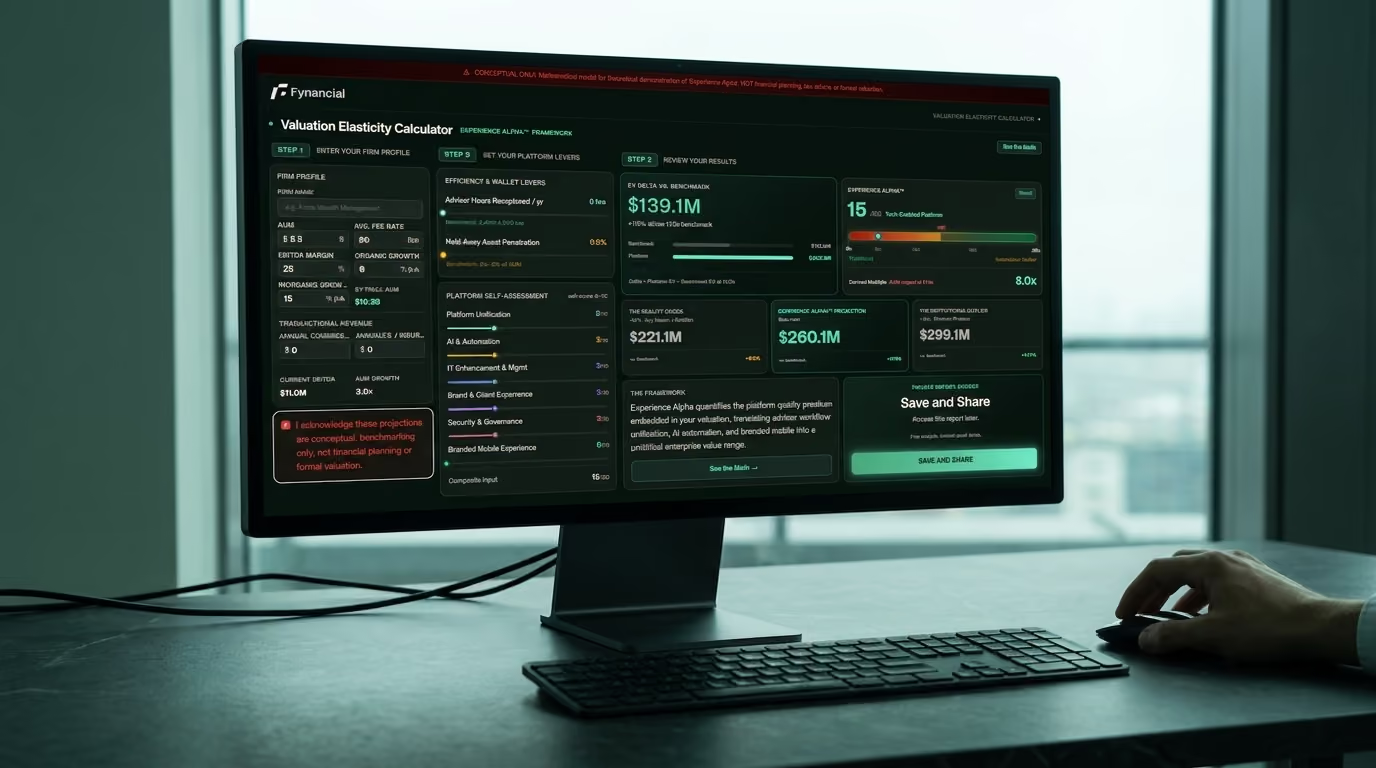
Run the Valuation Elasticity Calculator →
See Who We Serve →
Book an Experience Alpha Audit →
The Fynancial Insights team writes on enterprise value, client experience architecture, and the platform decisions that shape valuation for independent advisory firms.
Related Insights





What firms say after launching with Fynancial
I am not exaggerating when I say our app has helped us win over $10M in new AUM between two separate prospects. The vision Fynancial has is incredible!

This highly personalized communication solution enables us to connect with clients like never before. Delivering real advice from real advisors with authentic, timely, human-centered guidance.
The Prime Capital app is our all-in-one hub. Seamless advisor to client communication, fully integrated with our core tech stack. The Salesforce integration ties it all together perfectly.
We are currently managing the majority of our client relationships daily through our app. It has been a game-changer, and I cannot say enough positive things about Fynancial and their entire team.

See your Platform Premium in 2 minutes
Model AUM → multiple uplift. Live. Under 2 min.
Enter AUM, headcount, and growth. The calculator maps how a branded client layer can move your valuation multiple, recalculating as you adjust inputs.