Firms keep buying leads they can't convert
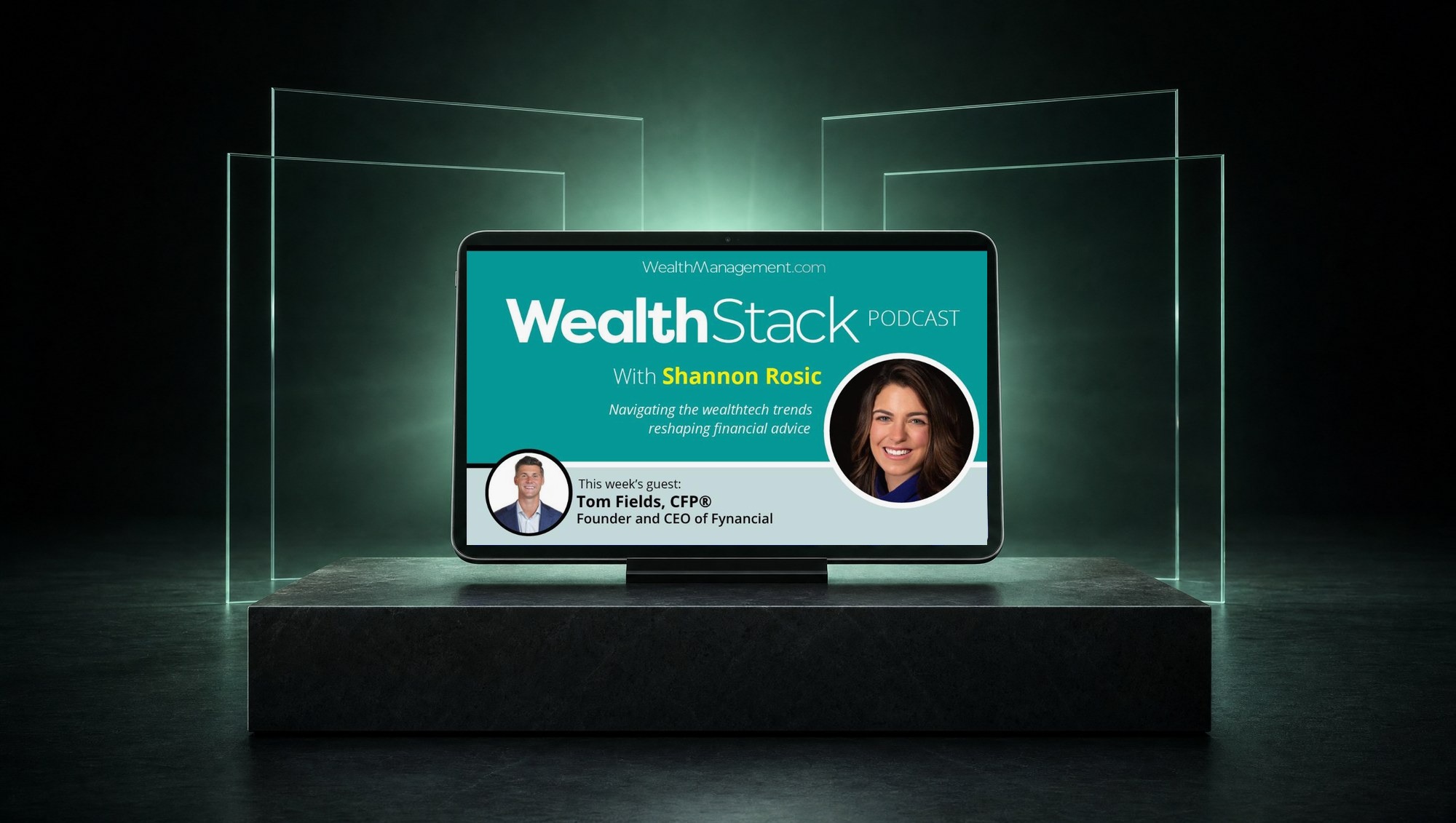
Tom Fields with Shannon Rosic on The WealthStack Podcast
Nothing happens unless the client sees what the advisor is trying to say.
An orthopedic surgeon in Orange County got his advisor's new app powered by Fynancial, liked it, and showed a surgeon friend at the hospital. The friend scanned a QR code on his phone. In the first four weeks after that firm launched its app, it had a $3.3 million referral.
The firm didn't buy a lead to get that client. One happy client had something he could show, and showing it took a single scan.
Tom Fields, Founder and CEO of Fynancial, told that story to Shannon Rosic on The WealthStack Podcast, and it sums up how Fynancial thinks about growth. Most firms trying to grow are spending at the top of the funnel and losing at the bottom. As Tom puts it, the real problem "is conversion in this industry."
Rosic asks what a tech buyer would ask
Shannon Rosic runs WealthStack content for Informa Connect, the group behind WealthManagement.com's technology programming, so she spends her year watching advisor tech get demoed at conferences. Her show has segments with names like Stats All Folks and Stack It or Whack It, and they keep guests from settling into a pitch. She opens with research on client expectations and asks what it means for firms. Then she asks the question a skeptical COO would ask: why has wealth management lagged every other industry on the client experience, and what does Fynancial actually do about it?
Tom's answer to the first half is about timing. The integrations that make a branded client app possible run on modern APIs that, he says, didn't exist five years ago. "Even if I had this idea and I knew there was a problem to solve, I just couldn't actually build the product." He also tells Rosic he used to describe Fynancial as "a client portal clients actually use."
There are two ways to grow, and most firms skip the first
Midway through, Tom gives Rosic the line she says she'll clip for social. "There's two ways to grow any business. We can make our current clients more profitable or we can go get new ones." Then: "Everyone ignores that first."
Firms, he says, either assume they already have all of a client's wallet or they never market to the clients they have. The tax work, the estate planning, the new strategy the investment committee is excited about all go out as a mass email to a segmented list. Most of it lands in an inbox next to every other business competing for that client's attention.
A firm that can put a specific opportunity in front of the specific clients it fits, in an app under the firm's name, stays top of mind. When something happens in a client's life, they come to you first. This is the cheapest growth a firm can find, and it's the half most growth plans leave out.
Referrals are the lifeline, and the process kills them
On new clients, Tom is blunt. "Client referrals. It's the lifeline." The problem is the number of steps between a happy client saying "you should talk to my advisor" and a meeting on the calendar. The client has to remember, find a phone number, make an introduction and wait for both sides to schedule. Each step is a chance for it to die.
Fynancial's answer is a refer-a-friend button in the firm's app. A QR code comes up, or the client texts a link, and the prospect can book a meeting or open the app and see what being a client looks like. Tom's comparison: "You don't buy a house without touring it first." Most RIAs ask prospects to sign paperwork before they've seen any of the client experience. Letting them in early is the fastest way to a yes.
He shares one more line, which a client of his uses at the end of every prospect meeting. After walking through tax-loss harvesting and planning, the advisor asks: do you text your friends and family, or do you email them? The prospect says text. "Well, that's exactly what we do for you."
Delivery decides whether AI matters
Rosic turns to AI, and Tom's first answer is about risk. Before an advisor explores any AI tool, ask where the data goes. If a firm is letting client data leave its firewall so a model can read it, "that's a huge red flag."
Then he describes what it looks like when the data stays put. An advisor in the car asks the firm's app for clients they haven't spoken with in 60 days. The AI reads the CRM and the conversation history, builds the list and drafts a note with a calendar link. The advisor edits it and schedules it for 10 the next morning. He tells a story about a pastor who remembered his and his wife's names after a single handshake, and says that same feeling is the goal when a firm sends a client a note about a company they actually hold, on the day it reports.
None of that is worth much if the client never sees it. "Nothing happens unless the client sees what the advisor is trying to say. I can't say it enough." AI and data are getting cheaper every month. The channel that puts the advisor's words in front of a client is the part that's still scarce.
The CRM has to think bigger
Rosic's last listener question is about a theory going around: that the industry doesn't need a better CRM, it needs a relationship operating system where communication is built in. Tom doesn't hedge. Ask any owner about the CRM and you hear the same complaints: advisors don't use it, notes are outdated, data is everywhere. He thinks CRMs used to be very sticky, and that "they need to start thinking a little bigger or they will be a piece of tech that gets replaced."
That's a strong position from a company that integrates with every major CRM. We think it's the right one. A system that holds every conversation but can't deliver anything back to the client is a filing cabinet. Fynancial's approach is to keep the CRM as the source of truth, write every message from the app back to the client's record, and handle delivery on top.
A referral button only works if clients want to press it
The $3.3 million story has a condition attached, and Tom names it. Fynancial measures the first impression right away, by what clients say when the app launches, because "a happy client is a great indicator that they're going to refer." The surgeon showed his friend because he was impressed first.
A firm that launches a client app with no plan for the first 30 days will get a referral button nobody presses. The firms that see referrals in month one design the launch: what each client receives on day one, who they hear from in week one, and what they can do in the app that they couldn't do before. Tom describes building that first month inside the app as an onboarding journey.
Count the steps in your referral process
This week, walk through what happens after a happy client tells a friend about you. Write down every step, from that sentence to a booked meeting on an advisor's calendar. Count who has to remember what, and who has to call whom.
If it takes more than three steps, you've found the bottom of your funnel, and it's probably where your best growth is leaking.
Near the end, Rosic jokes that Tom might have a new company tagline: creating fuzzy feelings. Tom doesn't argue. "I'm in. I'll ping Nate." (Nate is Fynancial's Head of Media and Brand Messaging.)
The conversation in short
Rosic opens by asking what makes Tom who he is, and he answers with the Five F's and the client who fired him over six months of silence. He gives a quick overview of who Fynancial serves, then works through Rosic's data on client expectations, comparing it to the way Netflix, Uber and Venmo moved everyday life onto the phone. He explains why the portals most firms offer are sidecars to planning and reporting software, and walks through the client experience itself: login by text and Face ID, compliant messaging, meeting notes, to-do lists and document upload. The middle of the conversation is about growth, including the two ways to grow, referrals as the lifeline and why conversion is the real problem. The AI section covers data security, an advisor working their book by voice, and personalization. Listener questions cover engagement metrics and the future of the CRM. It ends with Stack It or Whack It, where Tom stacks AI nudges for advisors and whacks Kentucky football.
Key moments
Timestamps from the episode video.
1:07 What makes Tom who he is
3:14 From advisor to founder, and the client who fired him
8:24 Stats All Folks: what clients expect now
11:10 Why wealth management lagged, and why the timing finally worked
13:02 What a digital experience platform means in practice
15:41 Keeping the personal touch when communication goes digital
19:20 Integrating planning, performance and the CRM
22:08 Two ways to grow, and why conversion is the problem
25:09 AI, data and delivery
27:38 Personalization, and the pastor who remembered names
31:39 Ask Us Anything: engagement metrics and a $3.3 million referral
33:35 Should the CRM become a relationship operating system?
35:32 Stack It or Whack It
Listen
The WealthStack Podcast, hosted by Shannon Rosic, Director of WealthStack Content and Solutions at Informa Connect. "The Digital Experience Platform Playbook." Published October 17, 2025. Runtime 37:41.
YouTube: https://www.youtube.com/watch?v=dQ7DFqOMTF4
Apple Podcasts: https://podcasts.apple.com/us/podcast/the-wealthstack-podcast-the-digital-experience/id1590369855?i=1000732301388
WealthManagement.com: https://www.wealthmanagement.com/financial-technology/the-wealthstack-podcast-the-digital-experience-platform-playbook-with-tom-fields
Nathaniel Stout is Head of Media at Fynancial and a U.S. Air Force combat camera veteran. He leads brand messaging, content strategy and video production, and edits the Fynancial blog.
Related Insights




What firms say after launching with Fynancial
I am not exaggerating when I say our app has helped us win over $10M in new AUM between two separate prospects. The vision Fynancial has is incredible!

This highly personalized communication solution enables us to connect with clients like never before. Delivering real advice from real advisors with authentic, timely, human-centered guidance.
The Prime Capital app is our all-in-one hub. Seamless advisor to client communication, fully integrated with our core tech stack. The Salesforce integration ties it all together perfectly.

We are currently managing the majority of our client relationships daily through our app. It has been a game-changer, and I cannot say enough positive things about Fynancial and their entire team.

See your Platform Premium in 2 minutes
Model AUM → multiple uplift. Live. Under 2 min.
Enter AUM, headcount, and growth. The calculator maps how a branded client layer can move your valuation multiple, recalculating as you adjust inputs.