Engineering Organic Growth

What has changed is the ability to engineer it.
For most of the history of independent wealth management, organic growth followed a simple formula: talented advisors with good networks, genuine expertise, and strong client relationships attracted new clients. Some of them, over time, built firms.
This formula worked. It produced the independent advisory industry that exists today: tens of thousands of firms managing trillions in assets, built on the personal credibility of the advisors at their centers.
It also has a fundamental limitation: it does not scale. Advisor-dependent organic growth scales with the personality, network, and availability of individual advisors. It cannot be standardized, replicated, or institutionalized in a way that survives advisor transitions, acquisitions, or generational succession.
The firms that are pulling away from the field right now are the ones that have figured out how to engineer organic growth: building the systems, the infrastructure, and the architecture that makes growth repeatable at the institutional level, not just the individual level.
The Anatomy of Advisor-Dependent Growth
To understand what engineering looks like, it helps to understand precisely what it is replacing.
In the advisor-dependent model, growth happens through:
Personal referral networks. The advisor knows someone who knows someone. A client mentions the advisor at a dinner party. A professional contact (an accountant, an attorney, a mortgage broker) refers a client. These referrals happen because of the advisor's personal reputation, and they flow to the advisor personally. Not to the firm.
Social proof at the relationship level. Existing clients refer new clients because they trust their advisor, specifically, their advisor. When asked why they referred, they describe the advisor: "She is incredibly thorough." "He called me the same day the market dropped." "She actually explains things in language I understand."
The referral is about the advisor, not the firm.
Meeting-by-meeting impression management. Growth depends on whether advisors are conducting the kind of meetings (thorough, proactive, well-prepared) that clients want to tell their network about. This is inconsistent across the advisor population by definition. Some advisors are exceptional meeting conductors. Others are technically competent but unremarkable in the client relationship.
What this model produces is a growth rate that is highly correlated with advisor talent and effort, and highly resistant to systematization. You cannot replicate the exceptional advisor's relationship style at scale. You can only hire more exceptional advisors.
What Engineering Changes
Engineering organic growth does not mean replacing the advisor relationship. It means building the infrastructure that amplifies it: making the exceptional advisor's relationship approach accessible at scale and elevating the average advisor's client experience to something referral-worthy.
There are three primary growth engineering components:
Referral architecture. Engineered referral programs do not wait for clients to think of a reason to refer. They create specific, contextually appropriate moments that invite sharing. After a financial planning milestone is completed, the advisor sends a branded message through the client app: "I've just finished updating your plan with the new projections we discussed. If you know someone who could benefit from this kind of planning, I'd be glad to have a conversation." The moment is right because the client has just had a positive experience. The mechanism is frictionless because the client can share the app with a tap.
Firms that have deployed structured referral architecture see referral rates that are 2x to 3x those of firms relying on unstructured advisor-initiated referral requests. The math of that improvement is significant. At a firm with 600 clients, moving from 20% annual referral rate to 40% generates 120 additional referral conversations per year. If 25% of those conversations convert at an average of $500K in new AUM, the result is $15M in new AUM per year from referral engineering alone.
Prospecting architecture. Engineered prospecting creates a systematic pathway from prospect identification to engagement to conversion. It gives advisors a structured tool for turning prospect meetings into compelling demonstrations of the firm's capabilities, not through pitch decks or performance charts alone, but through showing the prospect what it actually looks like to be a client.
A branded mobile app demonstration in a prospect meeting serves a specific purpose: it makes the quality of the client experience tangible and visible at the moment the prospect is forming their first impression. It is a physical artifact of institutional investment ("this is what we have built for our clients") that no competitor who relies on traditional portals and email can replicate.
Conversion rates in prospect meetings where the Fynancial app is demonstrated consistently run higher than meetings where the advisor is presenting only through planning software and verbal description. The app is evidence, not pitch.
Activation and engagement architecture. The clients most likely to refer are the clients most deeply engaged with the firm. Engineering engagement (systematic push notifications, proactive planning updates, consistent document sharing, structured post-meeting follow-through) creates the depth of client experience that generates referral motivation.
Clients who feel like their advisor is always one step ahead of them, always watching for relevant developments, always following through on what was discussed, those clients refer with enthusiasm. Clients who feel like they receive a quarterly statement and an annual call refer rarely, and sometimes not at all.
Engagement engineering through a branded mobile platform converts the in-between-meeting experience from a void to a touchpoint sequence. It is the infrastructure that makes excellent client service visible and memorable.
Measuring What You Are Building
The distinction between advisor-dependent and engineered organic growth is ultimately a measurement distinction. In the advisor-dependent model, growth happens. But nobody knows exactly why, or how to replicate it, or what would change if the top advisor left.
In the engineered model, growth is measured at every stage: referral rate by client segment, prospect conversion rate by meeting type, app engagement rate by advisor, post-meeting follow-through completion rate, client satisfaction by engagement frequency.
These metrics do two things simultaneously. They allow the firm to optimize: to identify what is working and invest in it, and to identify what is not working and fix it. And they generate the institutional growth story that institutional buyers pay the highest multiples to acquire.
A firm that can document a 38% referral rate among clients who have been on the app for 12+ months, compared to a 14% referral rate among clients who have not activated the app, has a compelling and defensible growth thesis. It can project forward. It can explain the mechanism. It can show institutional buyers what growth looks like when the platform is fully deployed.
That is an engineered organic growth story. It is worth significantly more at exit than "we have good advisors who bring in clients."
The Infrastructure Decision
Engineering organic growth requires a decision to invest in the infrastructure that makes it possible. That infrastructure is not primarily a marketing decision or a hiring decision. It is a technology and architecture decision.
The branded mobile app is the visible expression of that infrastructure: the interface through which referral moments, prospecting demonstrations, and engagement sequences are delivered. The underlying architecture (the integrations that populate the app with real-time client data, the compliance archival that captures every communication, the analytics that measure engagement and conversion) is what makes the engineering systematic rather than aspirational.
Firms that make this infrastructure investment in the next 12 to 18 months are positioning themselves to generate the growth data that institutional buyers are already beginning to require for premium multiple underwriting.
Firms that defer are watching that window narrow.
Explore Fynancial Prospecting Tools →
Learn About Fynancial Pulse →
Book an Experience Alpha Audit →
The Fynancial Insights team writes on enterprise value, client experience architecture, and the platform decisions that shape valuation for independent advisory firms.
Related Insights





What firms say after launching with Fynancial
I am not exaggerating when I say our app has helped us win over $10M in new AUM between two separate prospects. The vision Fynancial has is incredible!
This highly personalized communication solution enables us to connect with clients like never before. Delivering real advice from real advisors with authentic, timely, human-centered guidance.
The Prime Capital app is our all-in-one hub. Seamless advisor to client communication, fully integrated with our core tech stack. The Salesforce integration ties it all together perfectly.
We are currently managing the majority of our client relationships daily through our app. It has been a game-changer, and I cannot say enough positive things about Fynancial and their entire team.

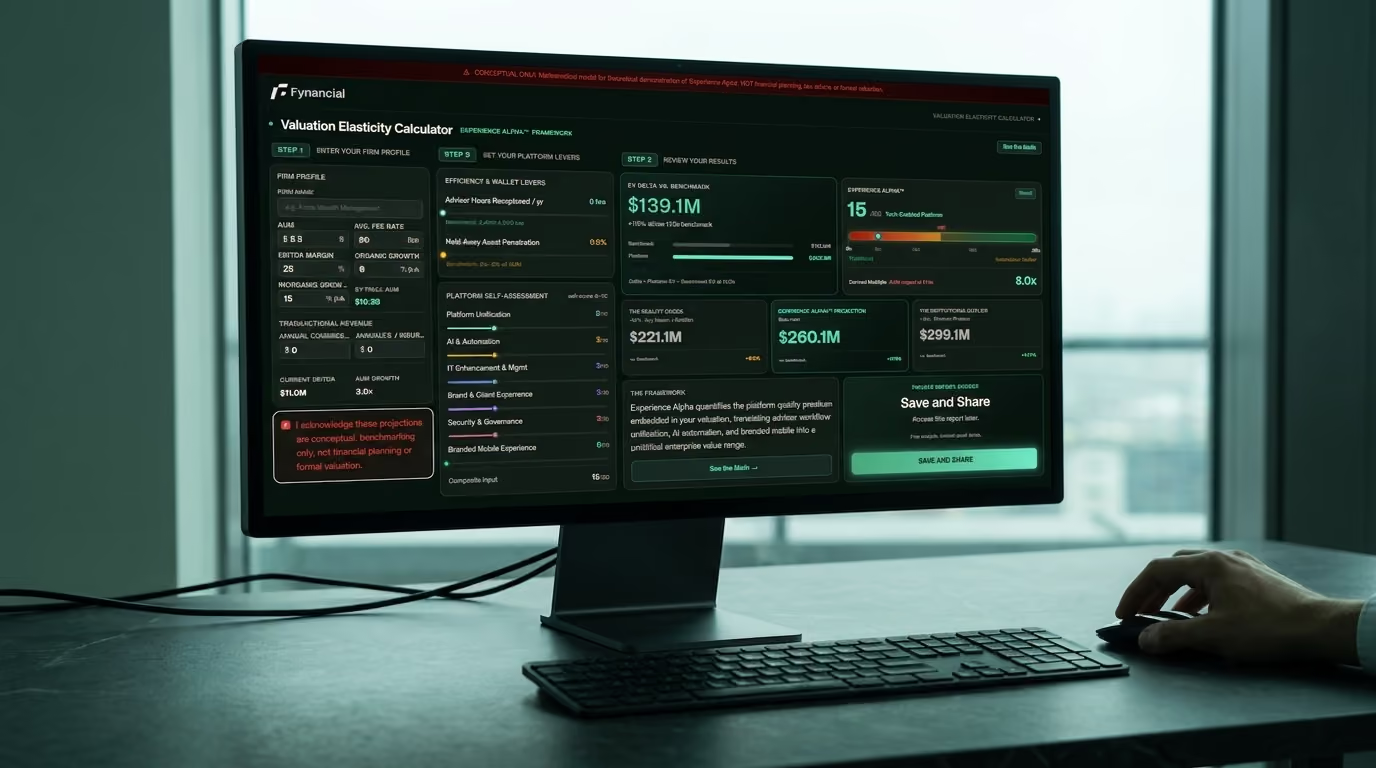
See your Platform Premium in 2 minutes
Model AUM → multiple uplift. Live. Under 2 min.
Enter AUM, headcount, and growth. The calculator maps how a branded client layer can move your valuation multiple, recalculating as you adjust inputs.