Due Diligence Begins at the Client Interface: What Your Technology Architecture Signals to Institutional Acquirers

Due diligence begins at the client interface.
Before an institutional buyer reads your QoE report. Before they model your revenue retention assumptions. Before they debate your management team structure. They look at your technology stack.
Not your traditional relationships. Not your investment models. Your technology stack, and specifically, the infrastructure you use to deliver the client experience.
This is not because technology is the most important part of an RIA acquisition. It is because technology is the most diagnostic. In 30 minutes with your systems documentation, an experienced diligence team can tell you what your business will cost to scale, what your client retention risk looks like, and whether the enterprise value you are representing in your pitch book is real or fragile.
What the Diligence Team Is Actually Looking For
When a PE-backed aggregator or strategic acquirer sends their operations team into your firm, they are answering three questions through your technology architecture:
1. Is client loyalty anchored to the firm or to individual advisors?
This is the key-person risk question, and your technology either answers it well or answers it poorly.
If your client's primary digital relationship is with an advisor's personal email inbox, and their secondary relationship is with a a third-party portal that carries no association with your firm, those relationships are advisor-anchored. When the advisor transitions, the relationship is at risk.
If your client's primary digital relationship is with a branded application that carries your firm's identity, your push notifications, your content, and your advisor's communications under your brand, that relationship has institutional anchoring. The advisor can transition without the client feeling the seam.
Acquirers pay a premium for institutional anchoring. They discount for advisor dependency. Your technology architecture tells them which one you have.
2. Can the client experience scale without proportional headcount additions?
The growth multiple in a wealth management acquisition is driven by one question: how much additional revenue can be generated on the acquired infrastructure without proportional cost additions?
Firms that rely on manual workflows, advisors personally managing every client communication, staff manually reconciling data across disconnected systems, compliance teams manually archiving communications, have a headcount-bound growth model. Every incremental client requires incremental labor.
Firms that have systematized their client experience through a unified digital platform have broken that link. The platform serves 500 clients as easily as it serves 100. That scalability is worth real money in an EBITDA multiple.
3. What is the integration cost of this acquisition?
Every acquisition carries integration cost. The question is how much.
A firm with a fragmented Frankenstack, six different systems that do not talk to each other, client data in multiple silos, no unified client-facing experience, carries a massive integration cost. Ripping out the legacy systems takes time, money, and carries client retention risk during the transition.
A firm that has already deployed a unified client execution layer on top of its existing systems presents a very different picture. The front-end client experience is already institutionalized. The integration project is a back-end systems migration, not a client relationship disruption.
The Platform Premium Is Not Theoretical
The RIA M&A data over the past five years tells a consistent story: firms with institutionalized technology infrastructure are trading at meaningfully higher multiples than traditional practices with equivalent AUM and revenue.
Duke Schillaci, a wealth management M&A advisor who has been on both sides of dozens of transactions, summarized the current market dynamic clearly: institutional buyers are no longer just buying AUM. They are buying operational platforms. And the operational quality question starts at the client interface.
A $1B AUM firm with a unified, branded mobile client experience, a governed communication layer, and demonstrable client engagement metrics tells a different story to a diligence team than a $1B firm with the same revenue but a Frankenstack.
The difference in valuation between those two firms is not a rounding error. It can be tens of millions of dollars.
What to Do Before the Process Starts
The time to optimize your technology architecture for a diligence review is not when the LOI is on the table. It is 18–24 months before.
The firms that consistently command premium multiples have typically been building their institutional infrastructure for years, not months. They have a branded mobile app. Their advisors communicate through a governed channel. Their client data is aggregated in a way that makes the retention story easy to tell.
If you are thinking about a capital event in the next two to four years, the technology investment conversation should be happening now.
Not because the technology is expensive. Because the time it takes to demonstrate institutional adoption and engagement metrics takes 12–18 months minimum. Buyers do not pay premiums for technology you deployed last quarter. They pay premiums for platforms with adoption data.
The Diagnostic Question
Here is the simplest way to assess where you stand.
Open your smartphone. Ask yourself: if one of my best clients opens their phone right now, whose brand are they seeing when they check their financial picture?
If the answer is anyone's brand but yours, your diligence story just got harder.
If the answer is your firm's name, you are building the right kind of enterprise value.
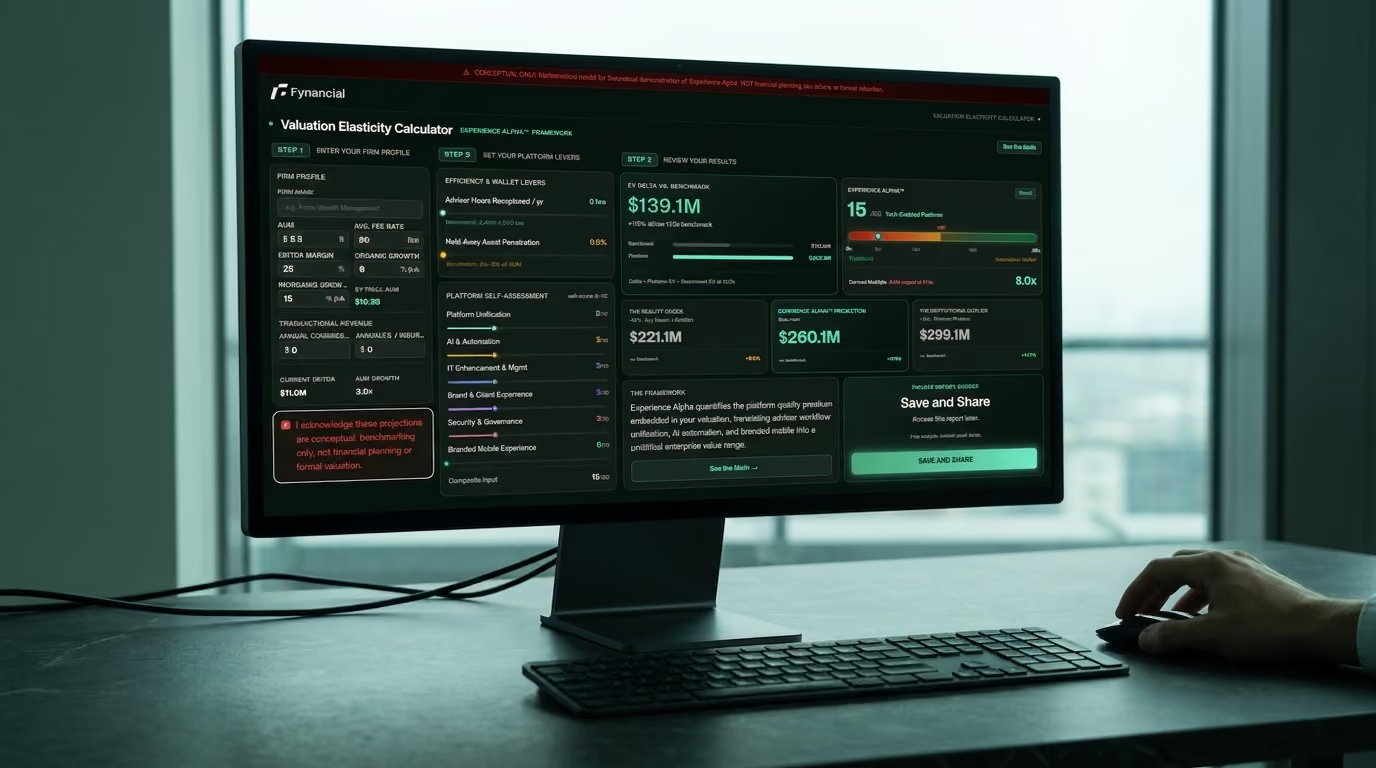
Ready to see what your current architecture signals to institutional buyers? Run the Valuation Elasticity Calculator →
The Fynancial Insights team writes on enterprise value, client experience architecture, and the platform decisions that shape valuation for independent advisory firms.
Related Insights





What firms say after launching with Fynancial
I am not exaggerating when I say our app has helped us win over $10M in new AUM between two separate prospects. The vision Fynancial has is incredible!

This highly personalized communication solution enables us to connect with clients like never before. Delivering real advice from real advisors with authentic, timely, human-centered guidance.

The Prime Capital app is our all-in-one hub. Seamless advisor to client communication, fully integrated with our core tech stack. The Salesforce integration ties it all together perfectly.

We are currently managing the majority of our client relationships daily through our app. It has been a game-changer, and I cannot say enough positive things about Fynancial and their entire team.

See your Platform Premium in 2 minutes
Model AUM → multiple uplift. Live. Under 2 min.
Enter AUM, headcount, and growth. The calculator maps how a branded client layer can move your valuation multiple, recalculating as you adjust inputs.