Regulatory Complexity Is an Architectural Constraint, Not a Competitive Moat

Healthcare solved HIPAA-compliant mobile a decade ago.
Every conversation about modernizing the wealth management client experience eventually reaches the same moment: "We would love to do something like that, but compliance."
Sometimes this is a legitimate technical question about how to build a compliant digital experience. More often, it is a thought-terminating rationalization that protects the status quo.
Healthcare handles HIPAA. Banking handles PCI DSS. Government contractors handle ITAR and FedRAMP. These are arguably more stringent regulatory environments than FINRA and SEC oversight of a registered investment adviser.
And every one of those industries built modern, mobile-first client experiences that comply with their regulations. Not despite the regulations. Within them.
The Architecture That Healthcare Built
A decade ago, the healthcare industry faced the exact same challenge that wealth management is grappling with today: how do you deliver sensitive, highly regulated data to patients through a mobile application without violating HIPAA's privacy and security requirements?
The answer was architectural. Healthcare did not decide the compliance burden was too high. They built a "Governed Data Gateway", an intermediary layer that decouples the complex, sensitive back-end data systems (the EHR, the billing systems, the lab results) from the patient-facing mobile application.
The data flows through the gateway, where compliance controls are applied, encryption, access logging, consent verification, data minimization, before reaching the patient's phone.
The patient sees a clean, consumer-grade mobile interface. The compliance team sees a fully governed, audited data transmission. The regulatory requirement is met through architecture, not through denial.
The Wealth Management Version
Fynancial's Trust Boundary is the wealth management equivalent of healthcare's Governed Data Gateway.
The complex back-office systems, the CRM, the performance reporting engine, the planning software, the compliance archival platform, continue to operate exactly as they do today. The data they generate does not flow directly to the client.
It flows through the Trust Boundary, where:
- Communications are archived to Global Relay or Smarsh in real time
- AI-generated content is reviewed by the advisor before delivery
- Access is logged with a complete audit trail
- Encryption is applied to all data in transit and at rest
- FINRA-required recordkeeping standards are met by the architecture itself
The client receives a clean, premium, branded mobile experience. The compliance officer has a fully governed, documented record of every interaction. The regulatory requirement is architectural, not aspirational.
The Real Question
The question is not whether it is possible to build a FINRA-compliant mobile client experience. Hundreds of Fynancial clients have already done it.
The question is whether compliance complexity is being used as a reason to avoid a conversation that is fundamentally about organizational change management.
Deploying a new client experience platform means asking advisors to change how they communicate with clients. It means training staff on new workflows. It means making a capital investment in infrastructure that does not have an immediate, visible P&L impact.
All of that is harder than saying "our compliance team won't allow it."
But the firms that are using compliance as an excuse are falling behind firms that asked the same question, got the same answer from their compliance team, and then engaged their compliance counsel in the architectural conversation, rather than accepting the initial "no."
Getting Your Compliance Team to Yes
The most effective path to compliance approval for a new client communication platform:
Start with the archival story. Compliance officers are most concerned about recordkeeping. Show them that every message sent through the platform is archived to Global Relay or Smarsh in real time, automatically, with a complete audit trail. This is more reliable than email archival in most firms.
Present the security documentation. SOC 2 Type II, ISO 27001, end-to-end encryption, GDPR compliance. Let the documentation speak before the conversation begins.
Engage on the governance architecture. Show the Trust Boundary, the separation between the back office and the client-facing layer. Demonstrate how AI-generated content is governed before reaching clients. Compliance officers who understand the architecture typically become the platform's internal champions.
Reference the healthcare parallel. If HIPAA-compliant patient portals are an accepted standard in an adjacent industry with comparable regulatory rigor, the argument that FINRA requirements make this impossible does not hold.
See Fynancial's full compliance architecture. View the Trust Center →
The Fynancial Insights team writes on enterprise value, client experience architecture, and the platform decisions that shape valuation for independent advisory firms.
Related Insights





What firms say after launching with Fynancial
I am not exaggerating when I say our app has helped us win over $10M in new AUM between two separate prospects. The vision Fynancial has is incredible!

This highly personalized communication solution enables us to connect with clients like never before. Delivering real advice from real advisors with authentic, timely, human-centered guidance.
The Prime Capital app is our all-in-one hub. Seamless advisor to client communication, fully integrated with our core tech stack. The Salesforce integration ties it all together perfectly.

We are currently managing the majority of our client relationships daily through our app. It has been a game-changer, and I cannot say enough positive things about Fynancial and their entire team.

See your Platform Premium in 2 minutes
Model AUM → multiple uplift. Live. Under 2 min.
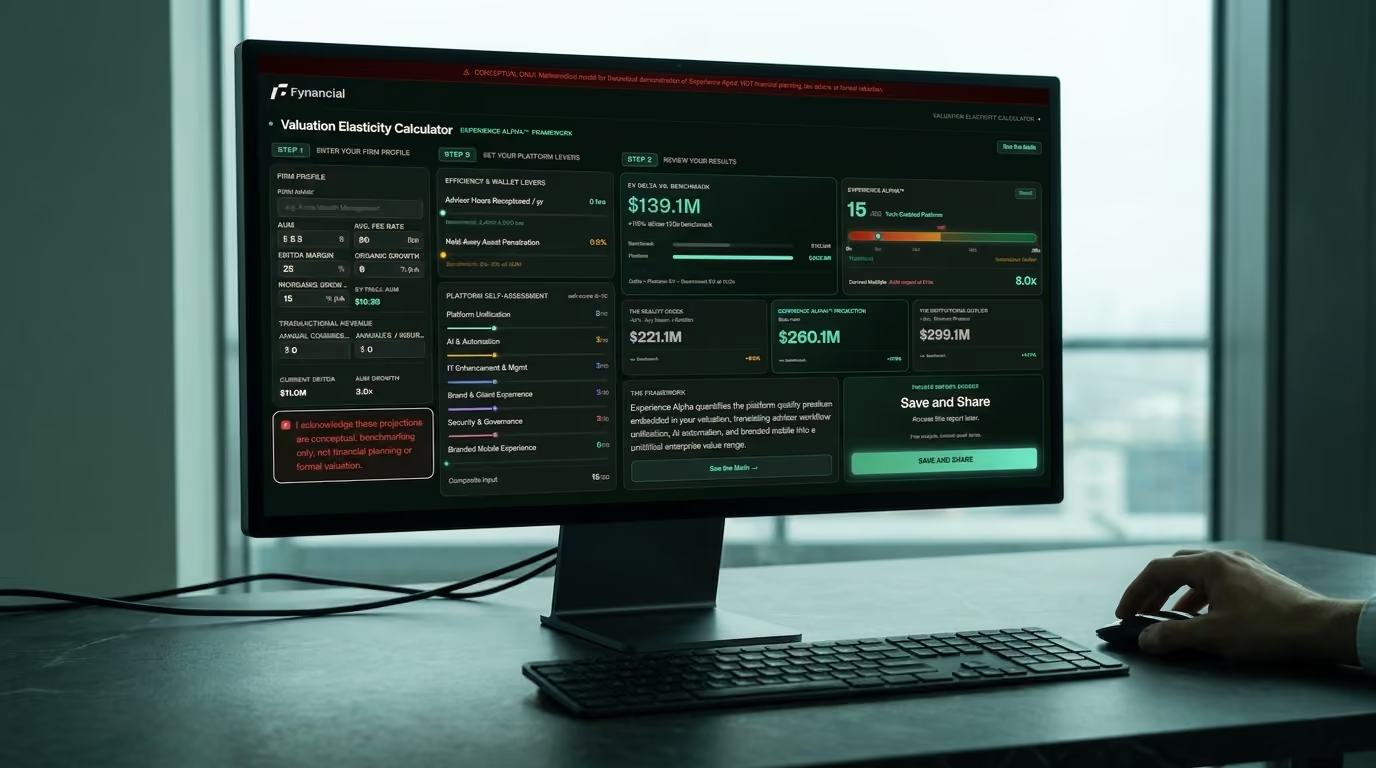
Enter AUM, headcount, and growth. The calculator maps how a branded client layer can move your valuation multiple, recalculating as you adjust inputs.