The best video metric is one question on your intake form
Tom Fields with Laura Garfield on The Real #Finfluencers, episode 35

People need to just see your face and see that it is you that is talking.
Kentucky got about three weeks of frozen ice last winter, which almost never happens. Tom Fields and his brothers cut a rink on the ice at their parents' place, rigged up a homemade Zamboni, and played hockey. Tom posted a clip, and it did well. "Still got it a little bit," he says, watching it back.
It's an odd post for the CEO of a wealthtech company, and it's part of the plan. Tom has built most of Fynancial's reach on video, and he doesn't measure any of it the way LinkedIn wants him to. He ignores likes and impressions. What he tracks is the answer to one question every new prospect gets asked.
A video producer who wants to see the receipts
Laura Garfield runs Idea Decanter, a production company that makes video for financial advisors, and she hosts The Real #Finfluencers to argue that advisors should be on camera. She also knows the trap in her own pitch. She opens the show by saying engagement feels good, but reaching new clients is what grows a business. Then she pulls up Tom's actual posts, one by one, and asks him to explain each one. She's a hockey mom, so she starts with the rink.
Ask every prospect how they found you
Garfield asks whether video has actually grown Fynancial, beyond the likes. Tom's answer is a habit any firm can copy. Every time someone books a meeting, Fynancial asks a simple open-ended question: how did you hear about us? The answer is rarely an article or a Google search. "It's typically like LinkedIn or like your videos."
He saw the same thing at the WealthManagement.com awards in New York, where Fynancial won in the Client Portals category. People he'd never met walked up to tell him they liked his stuff on LinkedIn. "It is pretty amazing what reach can do, and just being authentic."
When Garfield gets to her last question, how he measures return on video, he's blunt about the dashboard. "I do not look at what LinkedIn throws up. The comments, the impressions. I don't even know what that means." He goes by what prospects say on the way in and what clients say once they're in.
Post the hockey too
Tom splits his content into two jobs. Some videos are for reach, the kind a stranger shares. Others are for the people who followed him because of the reach video and now want to know what he actually knows. His mix is a little over half Fynancial and the industry. The rest is family travel, hobbies, his faith and the rink.
"I don't want to be this robot that's always talking about Fynancial," he says. When he posts about the company too often, "I can feel it. I'm like, this is boring." His logic is the same one every advisor uses in a first meeting. You don't spend a whole dinner with a prospect talking about your process. People do business with people they like and trust, and they can't like you if all they've seen is the product.
That's harder for an advisor than for a founder, because compliance reviews what goes out. It's still the right instinct. The personal posts are what make the professional ones get watched.
Put your face on the announcement
Garfield shows a video Tom made to invite people to a product release webinar and asks why it beats a graphic with a caption. His answer is about trust. A stock image with generic copy wrapped around it gets scrolled past. "People need to just see your face and see that it is you that is talking." Showing up on camera tells your audience the announcement matters, because you made the time.
Garfield adds the line advisors should take from this: you don't have to run a fintech to make a video that fills seats at a webinar. A firm hosting a client event, a tax update or an estate planning night can do exactly what Tom did with a phone and a few minutes.
You get better with reps
For advisors who hate being on camera, Tom points to the gym. The first time you go, you don't know what you're doing and you're sore the next day. Keep going and you find a rhythm. He started making education videos as an advisor during COVID, and he says looking back they were "building the armor" for what he does now.
He also points out what nervous advisors forget. The clients watching already love you and trust you, "and they just want to hear from you." Money is one of the most emotional things in anyone's life, and an advisor who simply shares what's on their mind is doing a real service.
LinkedIn finds strangers. Your clients need the video somewhere else.
Tom built the company after losing a client who never saw his LinkedIn posts or his YouTube videos. On this show he's making the case for LinkedIn video. Both are true, because they do different jobs.
LinkedIn is where Tom finds people who don't know him yet, and it's great at that. It's unreliable at reaching a specific client, because the algorithm decides who sees what. Tom's ROI answer already shows the fix. He watches for clients who message his team about something they saw, because that means they're engaged with the brand. A firm that wants that from its own clients should send them its videos directly, under the firm's name, instead of hoping the feed delivers them.
Add one question to your intake form
Make "How did you hear about us?" a required, open-ended field on every new prospect form and in every first meeting. Don't use a dropdown. Write the answer in the CRM in the prospect's own words.
In three months you'll know which videos, posts and people are bringing in business, and you can stop guessing from the impressions count.
Garfield closes the show with the line she uses for every advisor who's still nervous: "If Tom can do it, you can do it, too."
The conversation in short
Garfield opens by separating engagement from growth and asks how important video is to Fynancial. Tom says it's the main way people hear about the company, and the "How did you hear about us?" answers prove it. He tells the story of strangers at the WealthManagement.com awards night who knew him from LinkedIn. They watch his hockey clip and talk about reach videos versus expertise videos, then his rough content mix of a little over half business. Garfield pulls up a webinar invite and asks why video beats a static graphic. Tom says people need to see your face. She shows Fynancial's product videos and asks what advisors can learn from being on camera. Tom answers with reps, the gym, and the education videos he made as an advisor. They finish on how he measures return on video: what prospects say and what clients share, never impressions.
Listen
The Real #Finfluencers, episode 35, "Tom Fields on What Actually Works with Video," hosted by Laura Garfield of Idea Decanter. Published May 14, 2026.
YouTube: https://www.youtube.com/watch?v=s6u209_YLWI
Apple Podcasts: https://podcasts.apple.com/us/podcast/ep-35-tom-fields-on-what-actually-works-with-video/id1825169167?i=1000767775513
Spotify: https://open.spotify.com/episode/6s9G1kB3WrNOe96ov91gVC
Key moments
Timestamps from the episode video.
0:36 Why video is everything for Fynancial
1:00 Has video actually grown the business?
1:52 Strangers at the awards night
2:16 The hockey clip
4:05 How much content is about the business
5:23 Using video to fill a webinar
6:51 Lessons from being on camera
8:17 Treat it like the gym
8:58 How Tom measures return on video
Nathaniel Stout is Head of Media at Fynancial and a U.S. Air Force combat camera veteran. He leads brand messaging, content strategy and video production, and edits the Fynancial blog.
Related Insights



What firms say after launching with Fynancial
I am not exaggerating when I say our app has helped us win over $10M in new AUM between two separate prospects. The vision Fynancial has is incredible!

This highly personalized communication solution enables us to connect with clients like never before. Delivering real advice from real advisors with authentic, timely, human-centered guidance.
The Prime Capital app is our all-in-one hub. Seamless advisor to client communication, fully integrated with our core tech stack. The Salesforce integration ties it all together perfectly.

We are currently managing the majority of our client relationships daily through our app. It has been a game-changer, and I cannot say enough positive things about Fynancial and their entire team.

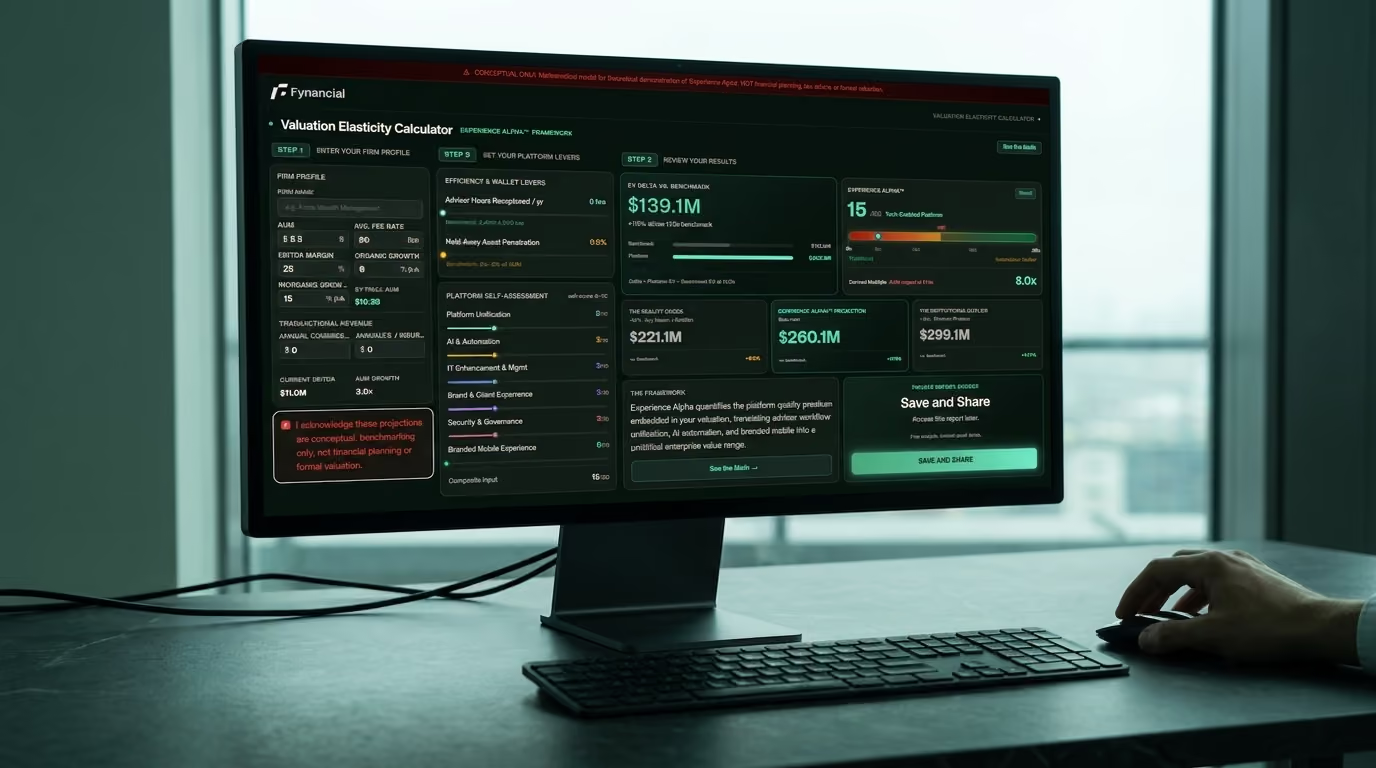
See your Platform Premium in 2 minutes
Model AUM → multiple uplift. Live. Under 2 min.
Enter AUM, headcount, and growth. The calculator maps how a branded client layer can move your valuation multiple, recalculating as you adjust inputs.