Installed Software and Adopted Software Are Different Assets. Only One Creates Value.

Most advisory firms have paid for technology their advisors do not use. The contract is signed, the tool is provisioned, the line item shows up every month, and adoption sits somewhere south of embarrassing. The firm blames the advisors for resisting change. The advisors blame the tool for not fitting how they work. Both are pointing at symptoms.
The real issue is that buying software and getting software adopted are two different projects, and firms consistently pay for the first while assuming they are getting the second. Installed software is a cost. Adopted software is an asset. The gap between them is where most technology budgets quietly die.
I Built the Wrong Priorities First
I know this gap intimately, because in the early years of building Fynancial I got it wrong. In 2023 I was proud that firms were paying us. Looking back, I would have traded some of those early contracts for firms that would use the product hard and tell me the truth about it, because revenue from a firm that never adopts teaches you nothing and predicts nothing.
Two things changed once I understood what actually drives adoption, and they are the two things any firm should evaluate before signing.
Adoption Test One: Does It Live in the Source of Truth?
Advisors live in the CRM. It is where the client record sits, where the workflows run, where the day actually happens. We were slow to build deep into Wealthbox and Salesforce, and while we were slow, onboarding was painful and nothing stayed in sync. The moment we treated the CRM as the source of truth and built into it properly, adoption stopped being a fight.
The principle generalizes to any client-facing platform you are evaluating. If the tool asks advisors to leave the CRM, maintain a second record, or remember to update two systems, it will not be adopted, no matter how good the standalone product is. Advisors do not sustain effort against their own workflow. A platform that does not live in your source of truth is not integrated, it is adjacent, and adjacent tools get abandoned. Ask a vendor exactly how their product writes to and reads from your CRM, and treat a vague answer as a prediction of low adoption.
Adoption Test Two: Who Owns the Onboarding?
The second thing I learned is that a product which changes how advisors work does not teach itself. Fynancial changes how advisors deliver advice, so we became a white-glove onboarding company by necessity. We document everything, set expectations before go-live, and engineer an early win in the first days, because software is dead unless people learn to use it and use it correctly.
When you evaluate a platform, find out who is responsible for adoption after the sale. If onboarding is a PDF and a login, the firm is being handed the hardest part of the project, which is behavior change, and left to do it alone. If the vendor owns onboarding, measures activation, and is accountable for early wins, they are selling you an adopted asset rather than an installed cost. That distinction is worth more than any feature comparison.
Features Are the Wrong Axis
Firms evaluate technology on feature matrices because features are easy to compare. Adoption is harder to see before you buy, so it gets skipped, and then it becomes the only thing that matters after you buy. The most capable platform in the category creates zero value if it sits unused next to the CRM. A simpler platform that lives in the workflow and comes with real onboarding creates value from the first week.
Data proved this out for us. Once we committed to deep CRM and integration work, connected firms finally got the thing every firm actually wants: one place clients go, one place everyone sees the numbers, sitting on top of the existing stack. That only happens when the software is adopted, not merely installed.
When you assess your next client-facing platform, hold the feature list lightly and press hard on two questions: does it live in our source of truth, and who is on the hook for adoption. The answers predict the return better than anything on the spec sheet.
See how the platform connects to the tools your firm already runs →
Tom co-founded Fynancial on the thesis that the gap between the quality of independent advice and the digital experience used to deliver it is one of the most addressable problems in wealth management. He leads product vision, enterprise partnerships, and the Experience Alpha framework.
Related Insights




What firms say after launching with Fynancial
I am not exaggerating when I say our app has helped us win over $10M in new AUM between two separate prospects. The vision Fynancial has is incredible!

This highly personalized communication solution enables us to connect with clients like never before. Delivering real advice from real advisors with authentic, timely, human-centered guidance.

The Prime Capital app is our all-in-one hub. Seamless advisor to client communication, fully integrated with our core tech stack. The Salesforce integration ties it all together perfectly.

We are currently managing the majority of our client relationships daily through our app. It has been a game-changer, and I cannot say enough positive things about Fynancial and their entire team.

See your Platform Premium in 2 minutes
Model AUM → multiple uplift. Live. Under 2 min.
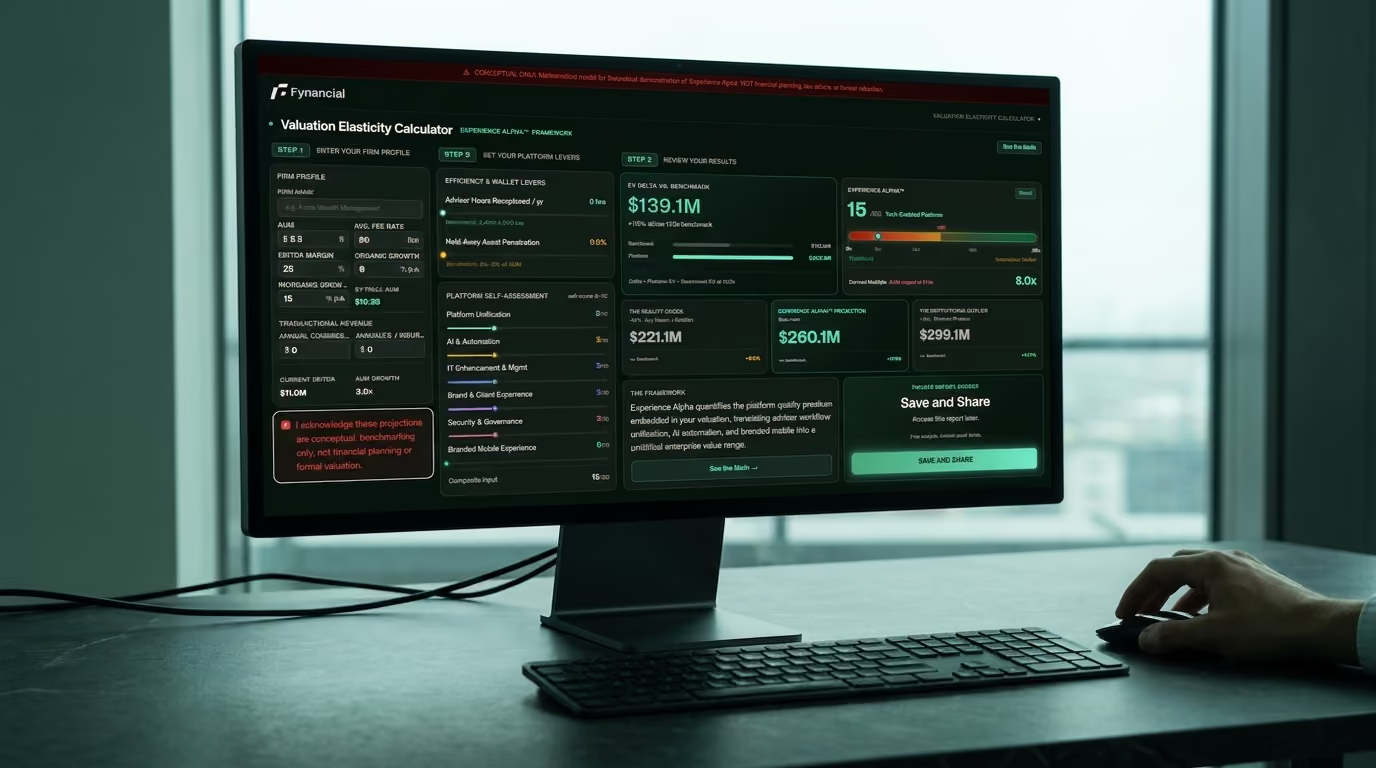
Enter AUM, headcount, and growth. The calculator maps how a branded client layer can move your valuation multiple, recalculating as you adjust inputs.